
Design Mind frogcast Ep.56 – The Future of Customer Experience
In this episode of the Design Mind frogcast we’re joined by Gagandeep Gadri, Managing Director of frog to explore the future of customer experience. We examine the gap between what organizations believe they offer and what customers actually feel they’re getting. Plus, we dive into the rise of AI in business and the co-evolution of human-AI chemistry.
Listen to the podcast episode below. You can also find the Design Mind frogcast on Apple Podcasts, Spotify and anywhere you listen to podcasts.
Featured in this episode
Episode Transcript:
Design Mind frogcast
Episode 56: The Future of Customer Experience
Guest: Gagandeep Gadri, Managing Director, frog
[00:00:03] Elizabeth Wood: Welcome to the Design Mind frogcast. Each episode, we go behind the scenes to meet the people designing what’s next in the world of products, services and experiences, both here at frog and far, far outside the pond. I’m Elizabeth Wood.
Today on our show, we’re exploring the future of customer experience. To do this, we’re joined by Gagandeep Gadri, Managing Director of frog. Gagandeep has spent 25 years driving innovation and unlocking growth for leading global brands. Today, his perspective is further shaped by leading a team of more than 2,000 strategists, creatives, technologists, business and industry experts here at frog. He’ll share why, first and foremost, delivering superior experiences is about way more than individual transactions.
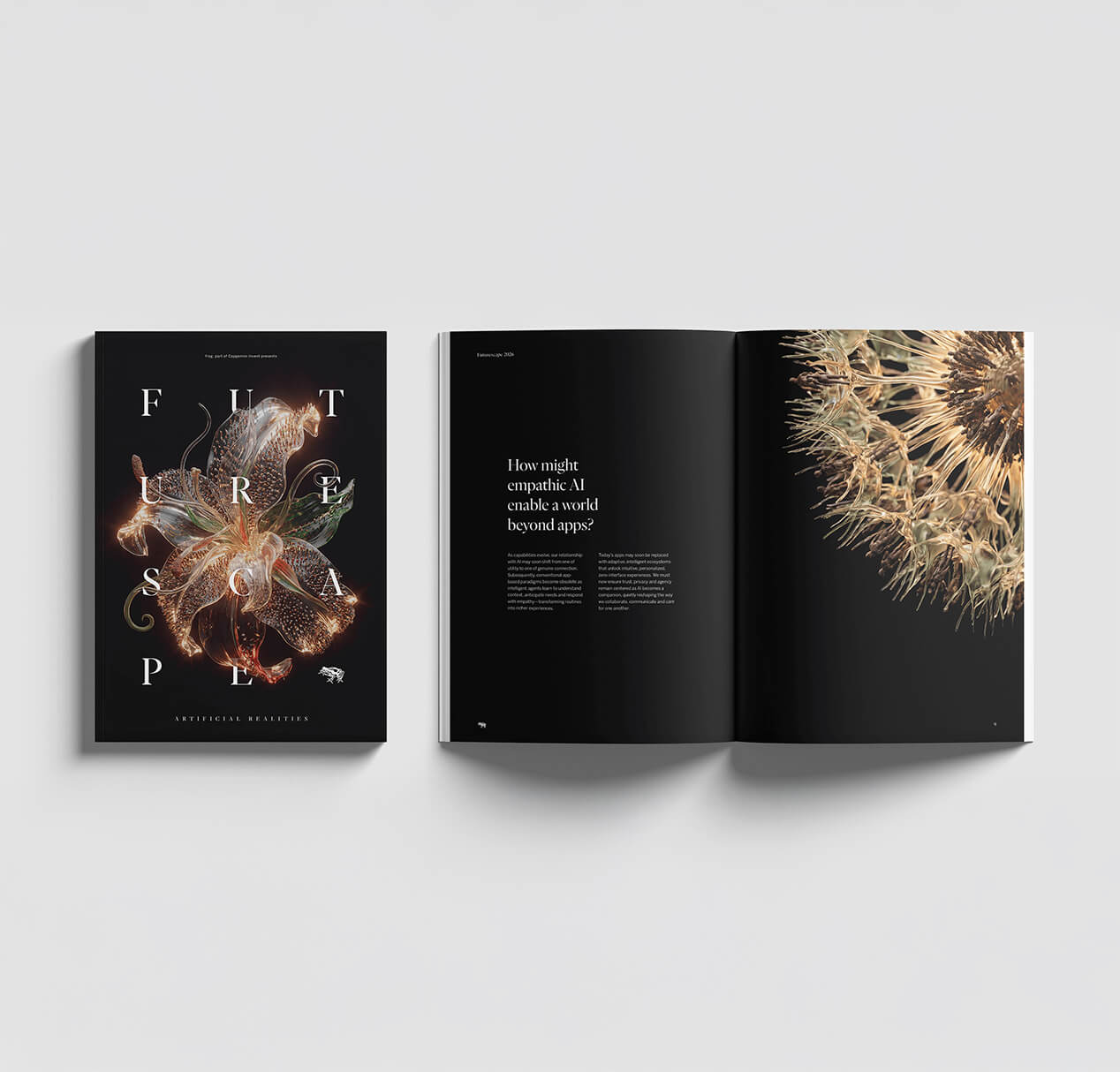
We also examine the gap between what organizations believe they offer and what customers actually feel they’re getting. Plus, we dive into the rise of AI in business and the co-evolution of human-AI chemistry, a topic covered in depth in our new report titled Futurescape: Artificial Realities. Check the show notes for a link, trust me, you’re not going to want to miss that.
But first, here’s Gagandeep.
[00:01:09] Gagandeep Gadri: So a typical day for me, you know what? There’s not a typical day. It’s always different. But normally, if I’m at home, I normally get up and I’m at the gym at seven o’clock. But because I live in the UK, I already have topics coming through from US from the day before, but from Australia, Asia, India and then Europe and UK is waking up, so it all goes a bit crazy. But most of the time, I always like to talk to clients to see what’s happening and how we’re performing and I like to randomly call someone in frog just to get a sense of what’s going on and what’s happening.
[00:01:42] Gagandeep Gadri: I really love everything we do at frog, you know, the way we help brands all over the world reinvent themselves. You know, really looking at what could be new products, new services, new experiences, but super importantly, how you deliver those experiences to make a real difference.
[00:01:57] Gagandeep Gadri: And you know, we have such a rich legacy with clients from over 50 years. And given the people that work at frog, they’re so loyal and fanatical about it. But also we’re recognized in the industry as well, with Forrester being leaders in CX strategy and with Forbes being one of the top consulting firms in the world.
[00:02:15] Gagandeep Gadri: In my role, I have the pleasure of traveling all over the world and visiting all of our different frog studios and there’s a lot that I still need to visit. But one of the things that always impresses me is the quality of the people and the quality of the work that is all over the world. It’s the same creativity, the same passion people have and the quality of the work really impresses me.
[00:02:40] Elizabeth Wood: Collaborating with clients across the globe means that Gagandeep notices some pretty interesting emerging trends. Here he shares the key developments shaping customer experience today.
[00:02:51] Gagandeep Gadri: So, you know, CX, it’s fundamentally changing. It’s not about being nice or a nice to have in an organization. It’s a real differentiator. Look, I ask everyone listening, you know, what are the experiences you remember? And it’s the ones that are really personal, have a human touch, meaningful and you remember that aeroplane ride, that hotel experience, that shopping experience. So it’s shifting experience to beyond transactions. And what we know is that if you get the experience right or really good. You get a higher customer satisfaction, but at the same time, that drives more sales, but also lower cost to serve as well. So that’s why organizations really need to deliver on experience, but not just ordinary experience. It’s about delivering a superior customer experience and I’m afraid if you don’t want to do that, then you might as well shut up shop and don’t do anything at all.
[00:03:48] Gagandeep Gadri: So we did some research, we asked organizations, do you think you’re delivering a great experience? And 85% of them said yes. But when we asked consumers, only 60% said yes. But of those consumers, we then asked them, do you feel really valued or really special? Only 3% said they did. So there’s a massive disconnect between what organizations think and then what consumers are thinking. So you need to solve that.
[00:04:17] Gagandeep Gadri: If an organization thinks they’re meeting the expectation, they’re not going to invest in it. But if your consumers are saying you’re not and actually it’s not very special, you need to listen to that and then understand why and what and start to make investments.
[00:04:31] Elizabeth Wood: Listening closely to customers and making them feel valued is essential. On top of this, organizations need to make sense of complexity to create truly meaningful experiences.
[00:04:40] Gagandeep Gadri: There’s lots of different types of people who do you target? But how do you do that within a world where there are so many different tensions going on economically and politically and we want to do better on the planet as well. So how do you marry all of that complexity and deliver a superior customer experience?
[00:04:58] Gagandeep Gadri: Our realities are being challenged every single day. So what do I mean by that? Firstly, as a consumer, you have so many choices about what you could do, so being loyal to a brand or thinking on the experience often don’t happen so much as convenience or what’s in front of you or some other choices which drive your decision. Now, as an organization, you’ve got so many people in the world. The globe is so small, but it’s so big at the same time. So which customers do you target? What do you say to them? How can you be exclusive, but also inclusive of everyone as well? All of that in a dimension of economic turmoil, geopolitical tensions everywhere makes it super hard for an organization to make longer term decisions. And in everyone’s mind, really importantly, is our planet and how do we do things in a more sustainable way, looking after not only the organizations, but looking after society and the planet at the same time. So addressing all of those different topics is hard.
[00:06:07] Elizabeth Wood: During our conversation, Gagandeep offered a set of beliefs to help shape a more connected, sustainable and customer-centric approach.
[00:06:14] Gagandeep Gadri: There are a couple of beliefs that I have which are super important when you’re looking at experience. Look, the first one is, the only one constant in life is change. As an organization we’ve seen 50 years of change, right? How do you bring real emotion into products? How do we then bridge physical and digital? And now, how do you do all of that in a sustainable way? So lots of change that you have to do as an organization, you have to be ready to face into it. The second thing is, we believe that the world is on a dual transition to become more sustainable and to become more digital. But you can’t think of them separately. You have to address the two things together and that’s what we call eco-digital. And the third belief is, I often talk to clients and they might be in a business-to-business perspective or a direct-to-consumer and the way you execute on experience in those areas is different, but actually the expectation is the same. If you’re a person and you work in a procurement department of a large organization, but you’re also out shopping, buying things, your expectations of what you would expect from a business-to-business is exactly what you would get from a normal consumer experience. So those expectations are set and need to be delivered in a business-to-business perspective as well. And I see that a lot in business out there organizations having to now really step up in a business-to-business perspective, because it’s the same people you’re dealing with and they have a certain expectation on experience, on service, on marketing and on engagement. So I think there are three beliefs, really, that we need to think about. Change is constantly happening. You need to be ready for it. The eco-digital era, how do we be sustainable and digital? And B-to-B expectations are set by B-to-C experience.
[00:08:07] Gagandeep Gadri: One of the things I see a lot when I talk to customer experience or marketing executives, is, how do you unlock budget in an organization to make change happen? There’s a lot of focus on the creativity and how things are so great, but you’ve got to have a business impact. So the first topic I wanted to talk about is very much about the hot topic of the moment, agentic AI. But I’m going to talk about agentic AI and human and how you use that to drive profitability. The second topic and the third topic are around hyper-personalization and meaningful engagement. But how do you use those to drive loyalty? So your customers are sticky, they come back, they buy more and drive more revenue. The final area I’m going to talk about is business reinvention. How do you really develop new products and new services? And that’s really important to drive growth. And I think it’s very important when we talk about these topics, we link them to a business outcome, because I think that’s a better way for you to get the support you need in a board in the organization and to get budgets and make change happen.
[00:09:16] Gagandeep Gadri: I think one of the things as CX executives we need to get much better at is a strategy which has clear outcomes to it. So having clear KPIs, which could be employee focus, customer benefits, but real profit and ROI return as well. So a stronger connect to business case as well. And I think it’s a muscle for customer marketing executives that we really need to focus on, because often when we speak to our clients. They have great ideas. But how does it realize in business and do a return on investment? So it’s making that link and following the process in the business in order to get the sign off and support that you need.
[00:09:57] Elizabeth Wood: More than ever, AI seems to be the topic of every business conversation. Here Gagandeep shares his view on why AI is so critical for the future of customer experience. As frog is part of Capgemini Invent, he also shares a bit about Capgemini’s Resonance AI Framework–another link you can find in our show notes.
[00:10:16] Gagandeep Gadri: The way I like to talk about agentic AI is agentic AI and humans. It’s together. And we should really consider AI as an extension to humanity. Why? First part is, if you automate jobs and processes using AI, that actually gives you more time. So the big question is, what do you do with that time? What are the new things we can do to drive better experiences, better outcomes or newer products and services? The second aspect is, you know, you’re shifting from one mind to many minds.
[00:10:50] Gagandeep Gadri: If you look at it, you know, internet democratized information, but AI is democratizing wisdom. It’s about not just one person’s intelligence, but a collective intelligence, a collective wisdom.
[00:11:04] Gagandeep Gadri: And you know, AI can never replace person-to-person connections. So if you want to thrive in the age of AI, it’s about becoming exceptionally good at collaborating, but thinking of AI and human together.
[00:11:17] Gagandeep Gadri: So we’ve developed a framework to help our clients navigate here and we need to look at it in two parts, you know, we call it the Resonance Framework. And the first bit is the what and the second bit is the how, right, the what is recognizing there are waves of AI that come there’s simple automation. There is more complex leverage of AI, maybe bringing physical and digital and biological things together, but there are waves of AI. So yes, there are different things happening. How you do it, we use a three-layer model in order to help our clients navigate it. You know, the first part is access to AI. What’s your base technology and what’s your base data? The second is, then, how do you adapt that for your organization? What’s the vision? What’s the organization that you have in order to leverage this? But the third part is the really important one and this is where frog plays a massive part. It’s the adoption, the human-AI chemistry. So what are the things AI does? How does that change what humans do? How do they adapt themselves and how do you make it work together?
[00:12:27] Gagandeep Gadri: Most of the AI tools that have been developed at the minute are for people like me that sit at a desk, yet 80% of the workforce are on their feet and they’re working with their hands. What are the AI tools for them? So we had one of the world’s leading grocers come to us and say, our coworkers in store, how can we enable them with AI so that they can deliver a better experience? So we’ve actually been working with them to develop a headset tool which allows someone who’s working on the shop floor to then respond more easily, have information about what product available, more detail about products, give alternatives to products if they’re not available. And actually the business case around that is 100 million in cost efficiency, but also revenue growth. So this is my point about leveraging AI with humans together in order to drive profitability.
[00:13:20] Elizabeth Wood: We’re going to take a short break. When we return, we’ll hear more from Gagandeep on the future of AI and customer experience.

[00:14:00] Elizabeth Wood: Now back to Gagandeep Gadri, Managing Director of frog. Here he shares more on specific uses cases for AI and customer experience.
[00:14:08] Gagandeep Gadri: Hyper-personalization. We’ve been talking about that for over 30 years, but now you can really do it. You know, you can take a picture and that picture can then be turned into a video and it could have different languages or different backgrounds or even people in it from that one picture or brand input that you give. So now you can really make hyper-personalization happen. But our clients are saying to us, you know, with this fundamental change that’s happening, what does that mean for the marketing department? How are they going to change?
[00:14:41] Gagandeep Gadri: In a lot of personalization, it’s about how you get the data and connect it into insights. You know, we have a long standing relationship with Unilever and we’ve set up something called the People Data Center, because it’s not just about the data, it’s what the people do with it and how you use it across the business. And I think it’s a great relationship we’ve had, which is really using data everything from developing a project product through to marketing it, through to the supply chain and the customer service, you know, understanding what you can do with that data and information. You know, how does your product compare with the second best product or a competitor product? What can you learn? How about when someone shoots a social media post about your product? How do you take that information and not just what they’re saying in the video, but where they’re standing and what they’re doing and bring all of that data in and I think all of that information just helps you personalize customer experience more and more.
[00:15:37] Gagandeep Gadri: You know, the marketing department has a key shift and a role when it comes to the overall experience. You know, what we’re seeing in the marketplace is it’s not just about the engagement or the communication. It’s about the end-to-end experience. Why? Because at multiple touch points, you’re engaging with customers. So if you want to land the brand position, you want to land the brand narrative, it’s happening in a continuous way along the experience and a key part of that are employees and co workers as well, right? They need to be on point with that message. So I think when we think about marketing, we need to think about it in an end-to-end way affecting the whole experience.
[00:16:16] Gagandeep Gadri: So one of the world’s leading beverage companies came to us and said, look, in a world in which you have agentic agents everywhere, they’re listening to you and actually beginning to make decisions on your behalf, what does that mean for my marketing department?
[00:16:31] Gagandeep Gadri: So the impact on marketing is going to be fundamental. Okay, yes, there’s some automation and efficiency gain and simplification, but the real power is on growth. Okay, if you’re more personal and you can scale more, you have a closer engagement, you’re going to drive growth. And you know, the magic comes from the hyper-personalization, which is all about knowing customers and consumers and bringing them to the moment, but then hyper-contextualization is these agents that really listen to where you are, what are you doing in the moment and then when you bring the two together, that’s where you can have the magic moments happen, right? Because it’s hyper-personalized, hyper-contextual. So real, great power there to drive scale and growth, but it’s a fundamental rethink of the marketing organization. You know it’s no longer a linear process, it’s more cyclical, it’s adaptive, but it’s also experience focused. It’s not just on the engagement. Yes, it’s got agentic at its core. So data and tech is important, but the human intuition, human traits to come through, are going to be super important. Otherwise, it’s all going to become the same, right? And so in a marketing department, yes, you’ll need data skills, technology skills, but creativity, authenticity, behavioral science, experimentation, thinking about end-to-end, all of these things are going to be really, really key, which is super important to get hyper-personalization right.
[00:17:59] Elizabeth Wood: Getting hyper-personalization right is just one lever for ensuring customer loyalty, but it will still require human oversight. During our conversation, Gagandeep stressed why AI cannot replace the human touch when it comes to ensuring value —specifically when it comes to the power of storytelling.
[00:18:15] Gagandeep Gadri: I think human creativity and ideas are still going to rule. Why? Because as human beings, we’re storytellers. We like the story. So when you look at a piece of art or you look at a new product, you like the art and the product, but we equally like the story. How is it made? How did it come to happen? Well, actually, if AI is doing all of that, there’s not much of a story there to tell. That’s why I think the engagement and the meaningful engagement part, there’s a huge role for humans to play in there, to drive that creativity and to drive those stories. IKEA came to us when they were talking to us about Ikea Family, you know, one of the world’s largest loyalty programs with really, in a world of digital, in a world in which their shoppers are shopping all over different channels, what’s the role of Ikea Family? And that’s where we looked at adapting Ikea Family to unlock a big question. Big question being: Your home is never done. So you might start off doing a bedroom or a kitchen, you then might move home. So how can Ikea Family play the role, play that partner of yours to help you complete the home all the time and having that insight and driving that in the engagement that you’re then doing makes loyalty happen and that’s what’s been really key and success. And the case study is on our website and there’s a lot of information about what we’ve done, but super, really good way where we’re leveraging technology, data and information, but with meaningful engagement., data and information, but with meaningful engagement.
[00:19:43] Elizabeth Wood: Ultimately, delivering on customer experience builds brands and drives loyalty. But it also unlocks unlimited potential for growth and business reinvention.
[00:19:52] Gagandeep Gadri: The final area I wanted to talk about was business reinvention, and that’s super important when it comes to customer experience because it’s all about what are the products, what are the services, what are the new experiences you want to give to consumers, right? And we learn so much data and information about consumers. How do we use that to reinvent what we do? And I think the first thing to say here is that it’s not a one off. Organizations need a constant muscle to reinvent themselves, because technology expectations are changing so fast around us, you need to be able to continually reinvest so that you’re relevant to consumers, because there’s going to be competition coming along to deliver new products and new services. So we talk about that as business reinvention, but it’s on a continuous basis.
[00:20:40] Gagandeep Gadri: So over the last year, we’ve been looking at a segment, luxury segment and across industries, so wealth banking, high-end cars, high-end clothing and jewelry, because it’s being reshaped and it’s being reinvented. So we’ve done this great research you can get on the website as well, where we spoke to thousands of High-Net-Worth Individuals about what their expectations are. And that was super important for us to understand, how do we reinvent in this area. And a couple of key insights from there were around, you know, there is a fatigue in the market setting in, there are signs of saturation and shifting priorities. Secondly, emotional expectations are really exploding. Consumers are really seeking meaning and connection transformations. You know, when I spoke about meaning. Experiences, human experiences. In this segment, it’s really, really key. But also, Gen Z is emerging as a cultural force. You know, they’re setting new standards. They want really good visual storytelling, authenticity and brand engagement. So all of these are rewriting the rules of what we call desirability and the way we approach that is on three dimensions when we talk to our luxury clients, right? First one is around elevating timeless craft with innovation. So how do you take the legacy, the heritage of your luxury brand, but innovate with technology? The second one is, how do you commit to uniqueness, but through real intimacy in digital moments and physical moments as well. But the final area is around, how do you inspire as a social leader as well, to sustain desire. So it’s really important, even in this market, sustainability is a key, key topic. So how do we make sure of packaging the experience? Yes, it delivers a luxury touch, but we’re very conscious about what we do and in a sustainable way as well.
[00:22:37] Elizabeth Wood: Across all industries, the dual focus of sustainability and digitalization plays a very important role, when it comes to delivering on customer experience.
[00:22:46] Gagandeep Gadri: One of the major industries which is really changing is transportation and the effect that has on sustainability. So we had the Kouros Group and Hyliko come to us to talk about, how do we decarbonize heavy duty trucking? So we worked with them to come up with a whole new truck-as-a-service platform. So instead of having your own trucks, you’re able to get trucks for as long as you need them, but they’re all hydrogen powered vehicles as well. So it’s green hydrogen, fleet management and maintenance. So how do you set that up as a service? So we worked with them to develop the proposition, to develop the business model that was going to be needed as well and, as Capgemini, then we worked with them to create the technology platform, the technology system that would be needed to drive that forward again, it’s a great case study on our website about how we’re reinventing businesses in a whole new area, but that delivers a better experience. So imagine as a company, if you use them as a service, you can talk about how you’re being sustainable in the experience you’re delivering for your consumers.
[00:23:55] Gagandeep Gadri: You know, experiences come in all shapes and sizes. It doesn’t have to be a private sector, big brand consumer experience.
[00:24:03] Gagandeep Gadri: We had Home Kitchen, a not-for-profit restaurant and social impact program come to us to help vulnerable people get out of poverty and into work.
[00:24:14] Gagandeep Gadri: Did you know every night in the UK, nearly 300,000 people face homelessness, with nearly two thirds of those in London. So home kitchen was set up to address the issue and combat the stigma surrounding it. Their mission is to help socially vulnerable people get out of poverty and into work. As frog, we did some pro bono work for them, which really focused on shaping the brand identity, the look, the vision and the look of the actual restaurant itself. And what we focused on was highlighting the journey of the individuals behind every meal, showcasing them building their futures one plate at a time.
[00:24:53] Gagandeep Gadri: As a brand, as an organization, your employees are your first customers, so take care of your employees and they’ll take care of your customers. This is super important and we’re seeing it more and more in the industry. You know, they give your brand narrative, brand messaging, brand position, positioning. So if they’re not happy and they’re not on message, your customers will pick that up. So so make that connection and make them feel very special.
[00:25:17] Elizabeth Wood: That’s our show. The Design Mind frogcast was brought to you by frog, a leading global creative consultancy that is part of Capgemini Invent. Check today’s show notes for transcripts and more from our conversation.
We really want to thank Gagandeep Gadri, Managing Director of frog for sharing his insights. Be sure to download our new report, Futurescape: Artificial Realities for 12 predictions and provocations exploring the future of human-AI chemistry.
We also want to thank you, dear listener. If you like what you heard, tell your friends. Rate and review to help others find us on Apple Podcasts and Spotify. And be sure to follow us wherever you listen to podcasts. Find lots more to think about from our global frog team at frog.co/designmind. That’s frog.co. Follow frog on X at @frogdesign and @frog_design on Instagram. And if you have any thoughts about the show, we’d love to hear from you. Reach out at frog.co/contact. Thanks for listening. Now go make your mark.

Gagandeep is an Executive Vice President and is the Managing Director of frog globally and the Head of frog in the United Kingdom. A future focused senior leader commanding 25 years of experience gained driving innovation, growth and delivering customer experience and digital projects across global brands. Above all, a bold innovator with the capacity to evoke positive change felt at both a human and organisational level.

Elizabeth tells design stories for frog. She first joined the New York studio in 2011, working on multidisciplinary teams to design award-winning products and services. Today, Elizabeth works out of the London studio on the global frog marketing team, leading editorial content.
She has written and edited hundreds of articles about design and technology, and has given talks on the role of content in a weird, digital world. Her work has been published in The Content Strategist, UNDO-Ordinary magazine and the book Alone Together: Tales of Sisterhood and Solitude in Latin America (Bogotá International Press).
Previously, Elizabeth was Communications Manager for UN OCHA’s Centre for Humanitarian Data in The Hague. She is a graduate of the Master’s Programme for Creative Writing at Birkbeck College, University of London.


We respect your privacy
We use Cookies to improve your experience on our website. They help us to improve site performance, present you relevant advertising and enable you to share content in social media. You may accept all Cookies, or choose to manage them individually. You can change your settings at any time by clicking Cookie Settings available in the footer of every page. For more information related to the Cookies, please visit our Cookie Policy.