
The Atomic Marketing Organization
Marketing is living through two changes at once, and they are pulling against each other.
The first is the rapid expansion of what the function can actually do. Generative and agentic AI have moved from internal pilots into production work in less than two years. Agentic AI in particular is rapidly rewriting traditional playbooks. Content, audience modelling, optimization, and even the orchestration of full campaigns are now within reach of a small team at a speed that, a few quarters ago, would have been treated as an ambition rather than a reality.
The second is the relative stillness of the structure built to carry that capability. Most marketing organizations still run on a role-based, department-shaped chart designed for a world of scarce expertise, manual production and sequential handoffs. It is, in effect, the operating model of a different decade trying to absorb the physics of this one.
This combination produces a function in growing tension with itself. The technology is ready to run, but the structure is not built to carry it. That tension also creates an opening. For the first time in two decades, there is a credible reason, and a viable way, to rebuild the marketing organization from first principles. The change is not cosmetic; it begins with the unit of marketing work itself.
The shape now emerging across early adopters has a single name: atomic.
Marketing has spent two decades scaling by adding layers. The next decade will scale by removing them.
Why the old structure is breaking
Before describing the new model, it is worth being precise about why the existing one is failing. The cause is structural, not cultural. The marketing function has accumulated more complexity than the role-based chart was ever built to hold.
The figures in Capgemini Research Institute’s ‘CMO Playbook 2025’ describe the situation directly:
64%
of CMOs say overcrowded MarTech is a key barrier to creating real customer experiences
30%
of organizations effectively use their internal data in marketing
42%
say their org structure leads to duplication of effort
40%
of marketer time is spent on reporting, not on building experiences
Taken together, these numbers describe a function spending most of its energy operating itself. The system absorbs the attention that should be going into the work.
Adding another channel lead, another platform or transformation program does not resolve this. The geometry of the org chart is the issue. With its sequential handoffs, briefs and approval queues, role-based marketing, was a thoughtful twentieth-century response to scarce expertise. In 2026, that scarcity is no more, and the same is true of execution. The scarce input is judgement: taste, brand instinct, and an informed view on what to do next.
The new organization needs to be built around the scarce input rather than the abundant one. This pattern is not unique to marketing. Microsoft’s 2026 Work Trend Index, drawn from 20,000 workers and trillions of Microsoft 365 productivity signals, identifies a small group of organizations the report calls “Frontier Firms.” They are human-led and agent-operated firms now pulling ahead of the competition. The most striking finding for any leader thinking about structure is that organizational factors, including culture, manager support and how talent is developed, account for more than twice the AI impact of individual capability and mindset combined. The conclusion is direct: The constraint on most enterprises today is not the people but rather the operating model around them.
The atomic marketing organization is the marketing function’s version of that operating model. It is the structure built to convert agentic capability into compounding value, by design rather than by accident.
What “atomic” actually means
The unit of marketing work is changing in shape. Where it was once a role surrounded by upstream and downstream handoffs, it is rapidly becoming an atom. An atom is one whole role with full ownership of an outcome, supported by a team of agents that carry out the execution work that used to require a traditional team behind it.
Atoms do not sit inside fixed departments. They cluster into hubs: small, composable groups that form around a clear outcome and dissolve again when priorities move on.
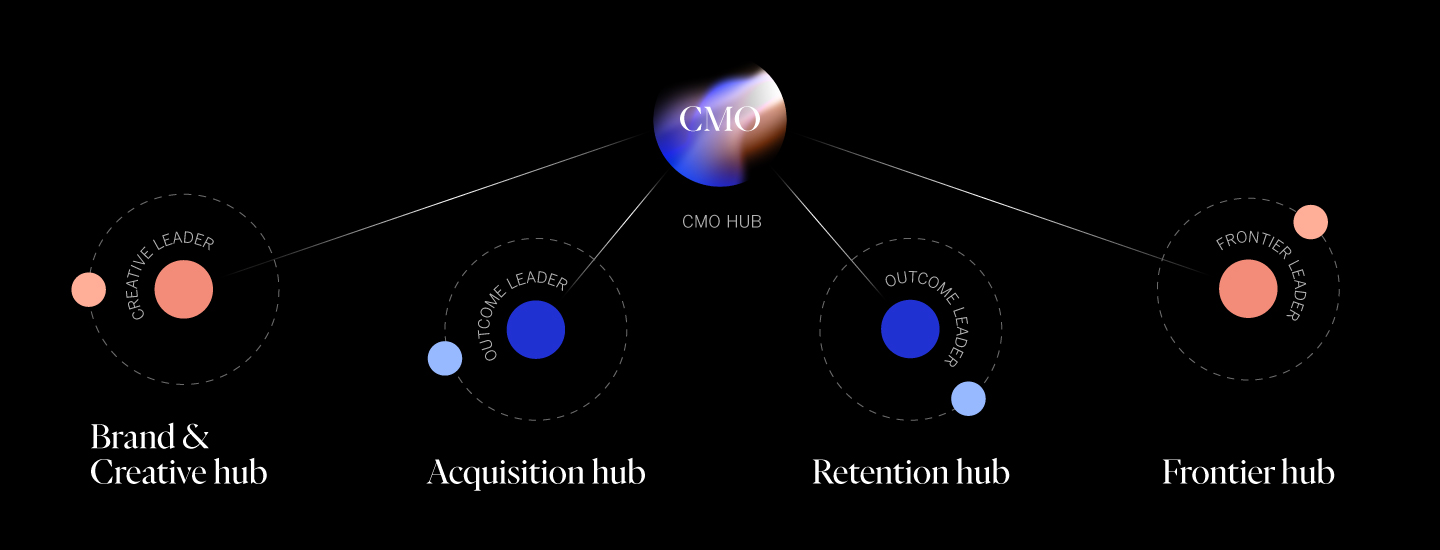
Most organizations piloting this model converge on a small set of named hubs.
- CMO hub
This hub sets strategic direction, adds nuances to priorities, and then cascades these to other hubs. This is a continuous rather than a one off or intermittent action.
The CMO Hub has a downstream responsibility to other hubs (brand, outcome, frontier etc.), but it also has a peer-level responsibility to the organization’s other functions and capabilities. - Brand & Creative hub
The purpose of this hub is to protect the outward-facing brand identity. It is responsible for setting guidelines on how to do this, how to create and generate content, how to express this identity, and how to train other hubs to use it (e.g., in approved brand assets). It also produces unprompted, unconventional ideas that fuel the organization. - Outcome hubs
This hub is typically organized around acquisition and retention, owning growth from end to end and carrying full authority over budget, experiments and performance. - Frontier hub
The frontier hub exists to keep evolving how marketing is done as the technology underneath it continues to move.
Each atom is a person carrying judgement, supported by an orchestrator agent responsible for the orchestration of the marketers’ responsibility and workflow. The execution lies with the marketers, their colleagues, and other agents. The hubs are designed to breathe, expanding and contracting around the priorities of the business rather than around legacy reporting lines.
Marketers become Outcome Leaders
Inside an atomic organization, the job of the marketer changes shape with the structure. The role is no longer defined by what the marketer produces. It is defined by the outcome the marketer owns. Outcome Leaders set the growth hypothesis, steer the agentic workforce toward the priorities they have chosen and intervene at the points where human judgement matters most. The craft has not disappeared; it has moved further up the workflow, into ideas, decisions and the design of the work itself. As a result, the marketer’s responsibility is no longer just a piece of the workflow; it has become intertwined end-to-end with it (from ideas, decisions, and design to judging, steering, and adapting), leading to an outcome.
Four characteristics that define the marketer as an Outcome Leader. They own the outcome, end to end, from acquisition through retention. They steer the workflow, taking responsibility for translating market signal into agent-led execution. They evaluate performance against compute, treating the cost and quality of agentic work as a metric they actively manage. And they create the never-seen-before brand moments that no AI can originate on its own.
This is the role most marketers find genuinely energizing once they step into it. The work becomes less about production and more about authorship.
Marketing roles are designed as indivisible units of value. One person, one outcome, with the relay race between specialists collapsed into a single point of ownership.
Every decision in the agentic model has a human owner already named inside the role. Responsibility is traceable through ownership, not enforced through additional approval checkpoints.
Outcome hubs form, dissolve and re-form as priorities shift. The execution layer carries data, brand rules and workflows across every initiative, so consistency is preserved as the structure flexes.
New capability arrives faster than any reorganization cycle can keep up with. Workflow designers become a core role, applying AI thoughtfully into the day-to-day work of marketers as the technology continues to move.
With agents carrying execution, adding a market or doubling output is no longer a headcount decision. More energy can be directed through the system to lift volume without lifting the budget line in proportion.
Human time is no longer absorbed by the operation of the system. It is reserved for moments of authentic creativity and high-judgement decision making. Premium, protected, deliberate.
Three of these principles, taken together, change how a CMO has to think about growth: scaling, decision authority and human capacity. Scaling becomes a question of system capacity rather than a question of hiring, because the execution layer absorbs the volume. For the organizations doing this seriously, that layer is an AI-native marketing system, and frog has a solution to that need. Decision authority becomes visible again, because each atom has a clearly named human at the center of it. And human capacity, released from production cycles, becomes the premium resource it was always intended to be —an input to protect rather than a cost to optimize first.
The model is designed to the company that adopts it. It is always in motion, because the priorities of the business are.
What it costs to get there
No marketing organization redraws itself over a weekend. The atomic model is best understood as an evolution that runs parallel to the existing organization. Most adopters begin with a single outcome hub, which is set up next to the legacy structure, with a clear adoption target. When that hub meets its bar, a second one follows. The Brand & Creative and Frontier hubs come later, once there is enough running for them to plug into.
The harder work usually sits one level down from the structure itself. It is the redefinition of the role the structure forces upon the team. Outcome ownership replaces campaign management, full-stack craft replaces channel specialization and workflow design replaces process management. In most cases the people moving into the new shapes are the same people who were already in the function. The transformation work happens inside individual careers, and the org chart is the visible trace of it.
There is also a governance question to answer before the model can scale safely. When agents carry execution, someone still has to carry the judgement around brand, claims and risk. The atomic model only works if every atom has a clearly defined human, ownership, autonomy, role, and judgement at its center. Without that, the organization has built a faster way to ship work it cannot defend.
Why the model works, and where to start
The atomic organization is designed to fit the company that adopts it. The workflows and the team configuration are set against whatever the CMO has named as priority for the period. As those priorities shift, so does the model. It is built to be in evolution, not to be deployed once and set in stone.
It holds up across very different organizational shapes. It works inside a 30-person marketing function and inside a 300-person one. It works inside a Fortune 500 and inside a challenger brand. The structure flexes with the priorities of the business. The unit of work, the atom, stays the same.
Governance and decision authority are implied in the roles and enabled through the execution layer. frog’s AI-native marketing solution unifies data, brand rules, and workflow guardrails across hubs, ensuring CMOs retain control as agentic capabilities scale. Human and AI accountability stays clear at every level, because the human owner of each judgement call is named inside the role rather than added on top through extra process.
For CMOs and marketing leaders sitting with all of this, the place to start is not the org chart. It is a single outcome the function is going to own end to end in the next quarter, and the small group of people, with the right agentic support around them, who will own it together. One hub. One clear outcome. A defined adoption target that decides whether the function commits to a second hub after it. That is the lightest credible entry into the model, and the one that does the most to demonstrate what the rest of the organization could become.
The remainder of the journey is one of authorship. The new structure can be drawn deliberately, by the function itself, on its own terms and with the people already in it. Or it can be drawn later, by someone outside the function, on conditions the function will have to accept. Frontier Firms, in the Microsoft sense, are the ones already doing the first version of that work.
Next in this series
Right now, it is vital that marketers reduce as much complexity as possible to facilitate the transition into an atomic marketing organization. The atomic model enables workflows and team structures to evolve alongside shifting priorities. But this is just the first step forward. Next, organizations will bridge data, workflows, content, analytics, and AI tools to create a single source of truth. We’ll get into the multivalent benefits of this in the next article in this AI-Native Marketing series.
Stay tuned for a focus on the return of the single marketer workflow to learn how the marketing stack is collapsing into a single working environment.

Tim works with Marketing & Digital leaders to uncover growth opportunities and deliver exceptional innovations and experiences. He specializes in the marketing domain and can connect strategy to data, technology and AI—and does this by fusing art and science together. Tim leads the Customer Data & Technology team at frog, developing advanced capabilities in MarTech and AI-powered innovations that help clients make their mark. Above all, Tim believes in using innovation to bring more positivity and joy to how people experience the world around them.

Steve is the Global Technology, Data & AI Leader at frog, part of Capgemini Invent. An expert in CX strategy and digital architecture, he guides organizations across diverse industries—from retail to defense—in building innovative, AI-native products, services & ways of working. Apply the latest breakthrough technologies like Gen AI and agentic AI, Steve helps clients in redefining customer experiences and enhancing the performance of their marketing, loyalty, commerce and frontline operations.


We respect your privacy
We use Cookies to improve your experience on our website. They help us to improve site performance, present you relevant advertising and enable you to share content in social media. You may accept all Cookies, or choose to manage them individually. You can change your settings at any time by clicking Cookie Settings available in the footer of every page. For more information related to the Cookies, please visit our Cookie Policy.