
Amplifying Clinical Care with AI
Time to change the tune
Healthcare innovation is often described as a solo performance: a new platform, a digital touchpoint, a clinical tool, a redesigned process promising efficiency, or an innovative product. Think of a single violinist performing Vivaldi’s “Summer.”
Yet healthcare does not work that way. Care never comes from a single actor or interface; it consists of interactions with multiple people, departments and systems. The orchestra is more accurate analogy than the soloist. Think of Dudamel and the Vienna Philharmonic performing Dvořák’s Ninth.
Patients carry the main melody; their needs and outcomes give healthcare its purpose. Clinicians set the rhythm, translating expertise into action. Processes form the score, determining how and when care unfolds. When these elements are aligned, care feels coherent and humane. When not aligned, even well-intentioned innovations produce friction.
Despite this interdependence, organizations still design in silos. Patient experience initiatives overlook clinician workload. Digital pilots ignore workflows. Process improvements focus on efficiency but neglect human impact. The result is innovation that seems promising in isolation but cannot scale or endure.
Meaningful innovation begins with designing a single system for both patient and clinician experience as well as operational processes. But if healthcare is an orchestra rather than a soloist, one crucial question emerges: Can AI become the enabler that truly brings all dimensions of the healthcare ecosystem into harmony?
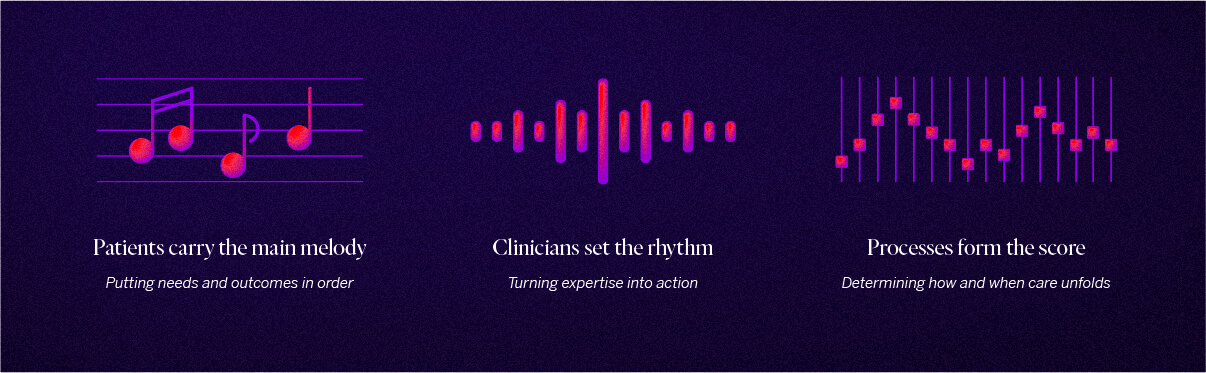
Healthcare innovation: The instrumental pieces
Excellent healthcare can only be delivered when all dimensions are given equal consideration. When processes are poorly designed, clinicians are unable to perform at maximum efficacy. When clinicians fail to operate at full potential, patients experience substandard care. Patients, too, can disrupt the balance when frustrated. Let’s take a closer look at each one, beginning with the reason healthcare exists: the patient.
Patient experience: The main melody
Patient experience is rightly recognized as a core dimension of healthcare quality. Safety, access, clear information, emotional support and outcomes shape how people perceive care across their journey.
Yet patients never experience care in individual fragments. Appointments, handoffs, instructions, waiting times and follow ups blend into one narrative: This is what receiving care feels like. They do not distinguish between clinical decisions, operational constraints or organizational boundaries. Rather, patients experience the system, especially when it breaks down.
This is why many patient-centered initiatives fall short. Organizations refine isolated moments (e.g., portals, surveys and service gestures) while patients continue to face delays, repeated questions and inconsistent information. What may look like separate improvements internally becomes friction, confusion or even abandonment from the patient’s point of view.
These gaps have real consequences. Fragmented experiences erode trust, complicate adherence and lead to disengagement. Missing information, unclear responsibilities and limited continuity do not feel like process issues; they feel like unreliable care. Research from the Agency for Healthcare Research and Quality (AHRQ) shows that failures in communication and coordination during transitions of care are among the leading causes of preventable adverse events, directly undermining patient trust and continuity.
Missing information, unclear responsibilities and limited continuity do not feel like process issues; they feel like unreliable care.
Crucially, patients experience not only what clinicians say or do, but rather how the system permits them to act. Time, attention and continuity are system outcomes that are felt personally. When workflows rush professionals or limit their presence, patients interpret it as a lack of support. When information flows smoothly and care feels coordinated, trust grows.
Seen this way, patient experience reflects the system’s overall coherence. The melody patients carry depends on how well people, processes and tools harmonize in practice. In the healthcare orchestra, patient experience is the main melody, but what is a melody without a rhythm? The quality of the melody depends on how well the entire system is tuned to support it every day.
Clinician experience: The rhythm that sustains performance
If patient experience is the melody of healthcare, clinician experience is the rhythm that sustains it. When that rhythm falters —due to overloaded agendas, fragmented tools, and constant interruptions— the entire system loses coherence. Quality of care is suboptimal not because clinicians lack expertise, but because the systems surrounding them make delivering good care difficult.
Over the past decade, clinician burnout has shifted from a workforce issue to a systemic risk. As the World Health Organization (WHO) has highlighted, burnout is not an individual failure, but an occupational phenomenon driven by chronic workplace stress that has not been successfully managed. Evidence consistently links clinician wellbeing with patient safety and outcomes: Exhausted clinicians are more prone to error, less able to communicate with empathy and more vulnerable to moral distress— the tension of knowing the right thing to do while being blocked by broken systems and constraints. Therefore, improving clinician experience is not about comfort or efficiency alone; it is a clinical and ethical imperative.
Evidence consistently links clinician wellbeing with patient safety and outcomes.
This is where many AI initiatives stumble. Too often, AI is introduced as an additional layer (e.g., through dashboards, alerts or recommendations) without removing existing burdens. Instead of reducing cognitive load, this new layer only adds to it. Clinicians do not need more intelligence competing for their attention; they need less friction, minimal uncertainty and better support at critical decision moments. When AI disrupts clinical flow rather than reinforcing it, adoption stalls, regardless of model accuracy.
The most effective uses of AI follow a different logic: Augmentation, not automation. Rather than replacing clinical judgment, these systems act as co-pilots, surfacing insights, supporting prioritization and helping clinicians navigate complexity while remaining in control. As The Lancet has repeatedly noted, technologies that ignore clinical workflows and human factors risk widening the gap between innovation and real-world impact.
Ultimately, AI’s value is shaped less by technical performance than by workflow integration and trust. Designing for clinicians is inseparable from designing for patients. In the healthcare orchestra, clinicians do not hand the baton to AI in the search tempo, but they do turn to it for the support needed to lead with confidence.
Processes: The score
If the patient experience is the melody and the clinician experience is the rhythm, processes are the score that makes coordinated care possible. They define how care is delivered: who acts, when information flows, where decisions are made and how exceptions are managed. In complex systems such as healthcare, quality does not arise from isolated excellence, but from well-designed interactions between people, tools, systems and workflows.
In the Spanish National Health System (SNS), universal coverage exists within a highly decentralized governance model. While this allows for local adaptation, it also creates variability in hospital processes, such as referrals, discharge coordination and information flow. These differences are often invisible to patients, but they determine waiting times, continuity and trust. Fragmented processes make care seem confusing or unreliable and overwhelm healthcare professionals, ultimately affecting patients.
Digitalization is often presented as the solution, but technology applied to poorly designed processes tends to amplify inefficiencies rather than resolve them. This is especially true in the case of AI, which can only add value when integrated into clear, interoperable workflows aligned with the real needs of patients and professionals. Without clarity in processes, AI becomes just another signal among many.
This is where service design and AI must converge. Service design clarifies end-to-end journeys and identifies where AI is truly needed. AI can then support these processes by anticipating bottlenecks, connecting signals and reducing friction. Well-designed processes create the conditions for AI to facilitate, rather than disrupt, and help healthcare provide consistent, humane care, just as a well-composed score breathes harmony into a orchestra.
From isolated notes to orchestration
Healthcare experience cannot be improved one note at a time. As previously detailed, patient experience, clinician experience and operational processes are not parallel tracks to be optimized independently, but interdependent dimensions of a single system. When one is misaligned, the entire performance suffers. When they are designed in isolation, even well-intentioned innovations struggle to scale or endure.
Patient experience reveals the system’s health. Clinician experience defines what care is realistically possible. Processes set the boundaries within which both operate. Treating any of these as secondary inevitably leads to fragmentation. Sustainable innovation requires recognizing interdependence as a design constraint, not an inconvenience. Service design therefore becomes a fundamental capability, not merely as a method, but as a way of understanding healthcare as an interconnected system. Rather than optimizing isolated interactions, it reframes the challenge around the conditions that must exist across people, processes and tools for high quality care to occur consistently and at scale. In doing so, service design establishes coherence and intent, creating the foundation on which technologies such as artificial intelligence can meaningfully contribute without fragmenting care.
In this context, artificial intelligence is not the conductor. It is an enabler. It helps organizations understand complexity, connect signals and reduce operational burdens. This results in the realization of the intended design, put into practice every day.
Meaningful healthcare innovation is not about playing louder, but about assembling a harmonious orchestra in which the melody rings out as clear as a bell and the rhythm is a reliable drum that beats throughout the day.

Gema is a Design Director at frog where she leads the Research and Service Design practice helping organizations design better products, services and experiences. With over 20 years of experience across industries including financial services, healthcare, mobility, retail and the public sector, she specializes in translating research into strategic decisions and innovation opportunities. She has led projects for organizations including BBVA, Mapfre, IKEA, Orange and Acciona, and is also a lecturer at Universidad Politécnica de Madrid.

Patricia is a Design Lead with over 12 years of experience shaping design-led transformation at the intersection of strategy, service ecosystems and digital innovation. She partners with organizations navigating systemic change, helping them translate complexity into structured, human-centered initiatives.
Across healthcare, retail and mobility, she leads multi-stakeholder programs that connect research, business ambition and product delivery. Her work spans innovation labs, open innovation platforms, intrapreneurship programs and digital service ecosystems, guiding initiatives from insight to MVP launch.
She has collaborated with organizations including GSK, Roche, Merck, Gilead, Ferrer, Grupo LAR and Unibail-Rodamco, driving strategic programs with measurable impact.
Originally trained as an architect, Patricia approaches transformation structurally designing not only solutions, but the conditions that enable innovation to thrive. Shaped by her experience living and working across different cultural contexts, she brings global perspective, cultural sensitivity and systems thinking to complex transformation efforts.

Fátima is a Senior Service Designer and Design Researcher with an Industrial Design background and over 8 years of experience leading complex, high-impact projects across healthcare, technology, and consumer industries in Latin America and Europe.
She specializes in service and product design, strategic consultancy, and patient- and user-centric innovation, with extensive experience collaborating with leading pharmaceutical companies such as Roche, AstraZeneca, Novartis, Bayer, among others. Her healthcare work includes the development of patient journeys, diagnostic and treatment algorithms, service optimization, and healthcare experience transformation within regulated environments.
In addition, Fátima has worked with global organizations including Google, Facebook (Meta), PepsiCo, Coca-Cola, Cupra, Basque Culinary Center, Festina, Acciona, and BBVA, among others, contributing to strategic and innovation-driven initiatives.
She has led multidisciplinary teams and end-to-end projects, excelling in stakeholder management, leadership, and cross-functional coordination. Her experience also includes AI-enabled projects, where she maps and analyses processes to identify high-value opportunities for the effective and responsible use of artificial intelligence.


We respect your privacy
We use Cookies to improve your experience on our website. They help us to improve site performance, present you relevant advertising and enable you to share content in social media. You may accept all Cookies, or choose to manage them individually. You can change your settings at any time by clicking Cookie Settings available in the footer of every page. For more information related to the Cookies, please visit our Cookie Policy.