
Design Mind frogcast Ep.62 – The Serious Side of Playful Design
On this episode of the Design Mind frogcast, we’re exploring the serious side of playful design. To guide us through the conversation, we’re joined by Jenny Savage, Senior Visual Designer at frog.
Jenny shares why it’s hard work to make things not feel like hard work. We also discuss the role of play in design, how creativity can unlock better experiences and why designing for neurodiversity—like designing for any kind of accessibility—makes it better for everybody.
Jenny also speaks about AI, dating apps, and why pulling from a deep well of silliness can help create more human experiences.
Listen to the podcast episode above. You can also find the Design Mind frogcast on Apple Podcasts, Spotify and anywhere you listen to podcasts.
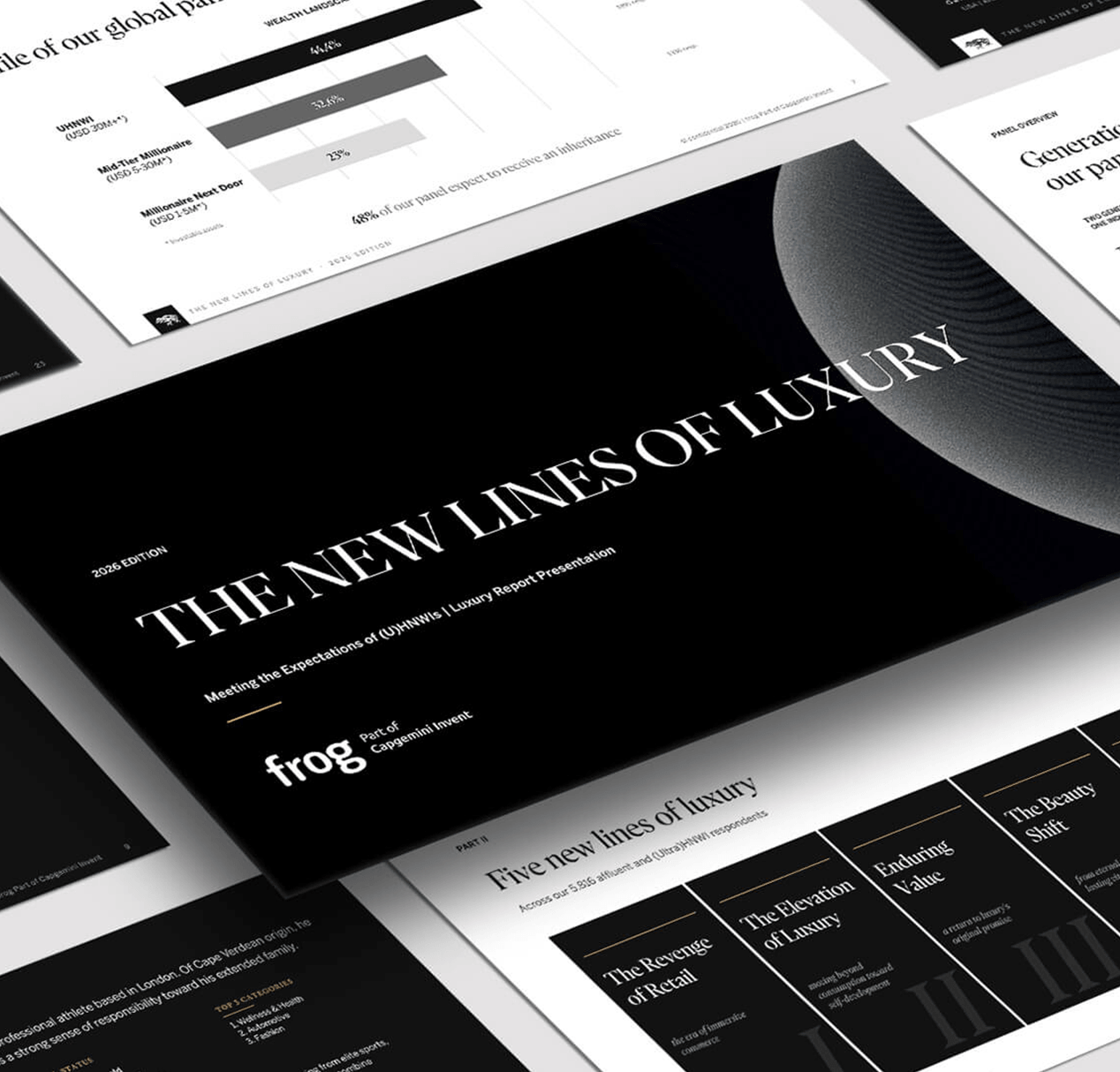
To find out about the evolving expectations shaping the future of luxury, download frog’s report, The New Lines of Luxury.
Episode Transcript:
Design Mind frogcast
Episode 62: The Serious Side of Playful Design
Guest: Jenny Savage, Senior Visual Designer, frog
[00:00:04] Elizabeth Wood: Welcome to the Design Mind frogcast. Each episode, we go behind the scenes to meet the people designing what’s next in the world of products, services and experiences, both here at frog and far, far outside the pond. I’m Elizabeth Wood.
Today on our show, we’re talking seriously about the role of play in the workplace. To do this, we’re joined by Jenny Savage, Senior Visual Designer at frog. Jenny’s path into design wasn’t a conventional one. From discovering graphic design through a library book in rural Kansas to building a career around creativity, systems thinking and problem solving, Jenny’s story is shaped by curiosity and a willingness to follow what fascinates her–even if that means being brave enough to get a bit silly.
Here’s Jenny now.
[00:00:47] Jenny Savage: I love seeing how things are made and I think that that’s something that most of the projects I get really excited about are those things where I get to kind of understand all the, like, inner logistics and kind of the plumbing of why people are making decisions, why companies are structured the way they are. I don’t know, I feel like I get to see this is such a boring cliche, but I get to see behind the curtain.
[00:01:10] Jenny Savage: I’m Jenny Savage, and I’m a Senior Visual Designer at frog. My trajectory from birth to frog — I’m going way back, when I was in third grade, we had this activity where we had to do a scavenger hunt and then tape all the things we found to a poster board and I thought mine was incredible. I’m always trying to get an A-plus, but this girl, I think her mother helped her — it was all color coordinated and laid out beautifully. It was all green and pristine and it kind of blew my mind. I didn’t know that you could do things like that and it really, one, made me angry and then, two, stuck with me. Later, I was trying to figure out what I wanted to do with my life and what I wanted to do in college and so my dad put me on to graphic design. I didn’t know what it was, but my library in my rural Kansas high school had one book called “What is Graphic Design?” and I read it. It had to be like maybe 30 pages long and in the back, it had a local college and I ended up going there. The stars aligned for me just to become a graphic designer and it really matched my way of thinking and the things that I like to do.
[00:02:18] Jenny Savage: I went to a community college, and it was run by women who had left an art school, and so it was really good, but it was only two years. And then when I went back to school, it was for a certificate program at a portfolio school. So, am I educated? Absolutely. But is it also mostly self-taught? I would say, you know, I’ve learned on the job.
[00:02:41] Elizabeth Wood: Not every career move is about climbing the ladder. For Jenny, one important step was learning where she could make her greatest impact.
[00:02:48] Jenny Savage: I was an associate creative director, and then realized I really got a lot of juice and satisfaction about doing the work, so I jumped back in as a senior designer.
[00:02:56] Jenny Savage: I think leadership is a calling and what’s surprising about going from a making role into a leadership role is it’s a totally new job and it’s three jobs and what I really loved about it was that you have so much ability to influence the process, which I really love. But I got really jealous of the teammates that were able to benefit from this new beautiful process and so I learned a lot about myself in the role and what I learned is what I really enjoy is solving the problem and spending the time doing some of the deep work, so the move back was really selfish in a way, because it was just what I loved doing and it’s what I get a lot of satisfaction out of.
[00:03:42] Elizabeth Wood: Behind the humor is a serious belief that creativity thrives when teams feel comfortable enough to experiment, collaborate and play, which sometimes includes getting a clever nickname.
[00:03:52] Jenny Savage: I love getting a nickname. I was so happy when someone called me the Rainbow Hammer. I could really see myself in it. I’ve got this, I think, bubbly, disarming personality. At least that’s what my therapist has told me. And I’m also really direct. I like to look at the system underneath a design and pick it apart and get really, really crisp, really clear about why we want to do something. So, I used to be brought into other people’s teams to not necessarily say the hard thing, but just to be another voice to, I think, support sometimes when someone was having a problem, or a problem wasn’t really—the solution wasn’t coming together in the right way. So people would bring me in to give feedback, and that’s where I got that nickname.
In addition to being called the Rainbow Hammer, I’ve been called the Vibe Mechanic, and more recently, a QuipMaxxer, and I feel like those three kind of tell a similar story of direct communication, but paired with, I think, a nice friendly, goofy energy.
[00:04:56] Jenny Savage: Yeah, having a kind of goofy approach to things can be really difficult, especially in client relationships. I’ve actually gotten feedback before and I also spend a lot of work on it, because I know that play and energy are a core ingredient of being, one, creative and collaborating with other people. But if you don’t know me and you don’t know that, it can appear really flippant and unserious and like you’re not really there to do the work. So, there is a balance, I think, sometimes that I have to strike. So sometimes there will be a game face or a step back or a little bit of the energy out, but it has to be something that I prepare for and I think that’s also a big part of being neurodiverse is that you have to be responsible and manage for parts of your personality or approach that might come across in a way that you don’t necessarily want. And I guess that’s also design at its core.
[00:05:55] Jenny Savage: Keeping things playful at work really is one of my favorite topics and things to talk about. I feel like I’m bringing it up internally constantly, because if you want good work, generally you need good designers, but if you want great work, those good designers have to be a really strong team and you also need a good process and the thing that all of those have in common is play. Play and creativity and just being soft and goofy, together gives you openness. It gives you good communication and then it kind of opens the door for the creativity. You need to be idiots together to be able to come up with new associations, new ways to solve a problem and it is a great social lubricant. So, I do try to goof up teams as much as I can, but because it can come across as so unserious and silly and we’re doing really serious work a lot of the time, these things, you know, mean a lot to a lot of people, so I find that it’s really useful if I compare the goof to a ritual. So, if we’re doing something like sports points. So instead of complimenting each other, we say you get five sports points. I had a team who kept track of all their sports points, which are absolutely fake things, over the course of like a year, and they had opened up a digital shop of things that you could buy with your sports points. If there’s a team where we have to have a decision, like two people have very opposing views, I call that Thunderdome. We schedule a meeting, two people come in, one idea leaves, usually it’s a combination of the two, but by calling it Thunderdome, what a fun energy to bring some combative spirit. I think that’s a nice framing, because then you get to, like, you know, leverage your energy appropriately.
[00:07:35] Jenny Savage: So, my energy, I feel like I pull from a deep well of silliness. Something about being in front of people just gives me all this showboating energy. So, if I want to do deep work, I do need to step aside, find my own little area, get a little zen and then go really deep, and I really do like the deep work, but as far as energy management, I do find that and I think it is in part because of my ADHD, that if I’m not paying too much attention, I burn out that battery and then when my entire weekend is spent in front of the couch with my dogs playing Power Wash Simulator. So, it is something that I need to be a little bit more careful about, but I think that scheduling can maybe accommodate some of that, which is also something that I like to think a lot about work systems.
[00:08:27] Elizabeth Wood: Designing for people means understanding how they think, collaborate and make decisions. For Jenny, workshops are one of the most powerful ways to unlock those insights and bring teams together around shared ideas.
[00:08:38] Jenny Savage: I always have loved facilitating workshops. I didn’t know it was a passion of mine until I came to frog and was able to do it. I did improv in high school, and some musical theatre and something about facilitating a workshop really scratches that itch for me and then I also really love bossing people around. The thing that I really like about workshops is that it takes a rigid structure that we know is going to funnel us into really good work, really good output, like it is very designed to get something specific. But then, the way we go about it is we’re introducing movement and kind of tactile pieces and play and energy specifically for the client in the room to make sure that we’re getting it really fast. It is an incredibly beautiful and efficient system, even though it can feel really silly and goofy. When I heard about workshops, when I first joined, they were putting people in hats, we were role-playing, some had wigs, so we don’t necessarily do that now, but because we’re all able to be in these shared whiteboards, I think it’s nice that people now have more agency to be able to move things around, add things that they want, but the trick is taking all that good stuff from the good old pre-Panini days of standing in a room and playing with toys essentially. The trick is going to be taking that and then being able to recreate that in our digital whiteboards. I like to use icebreakers to really get people to open up and like, set the tone. One thing that we do that you can do in any workshop to add a little bit of flavor is, we call it a rose ceremony. So, like, The Bachelor, it’s really just dot voting, you can just pick a different picture. We’ve done chickens, we’ve done golf puns. I think it’s a really easy way to add a little spirit without any extra work.
[00:10:33] Jenny Savage: I love facilitation and I don’t know why. It just really gives you a chance to see how other people are thinking and catch when they might be stuck in a loop. I used to help my friend design big haunted houses in his garage for a few years and it kind of, facilitating a workshop does feel like designing a haunted house in a way, you need to get people in the door, so it can’t be too scary and then as they, as they move through it, you really need to kind of think about pacing and when you’re giving people a break and then when you’re, when you’re surprising them with tasks and you don’t want to, you don’t want them to be able to see too far into it, so that they know what to expect, but at the same time, it’s we’re here for an output. So, you need to give them some assurances that their time is going to be really well spent. It’s such a fun thing to design for and participate in, but it’s, oh, it’s a lot of work. You can spend two weeks on what is two hours, but I always think it’s worth it.
[00:11:27] Elizabeth Wood: That balance between structure and creativity also informs Jenny’s perspective on neurodiversity. Living with ADHD has influenced a lot about how she works, especially how she thinks about designing products, services and experiences for others.
[00:11:40] Jenny Savage: Let’s start talking about ADHD. ADHD being the type of neurodiversity I am most familiar with. There’s a lot of kinds and I’ve found that it’s super misunderstood. Do I read about it? Do I read a lot of research? Absolutely, but there’s still things that people are finding out about it. But what I found in my work life and then doing experiments on the side, is that it’s actually about interest, not so much distractibility and it’s about momentum and efficiency. So, it’s painted as this distractible, messy kind of feeling. But what I found is that it’s actually whatever is the most interesting thing in the environment is going to get my interest. And if I’m moving, if I have momentum and I’m getting something done, I’m not going to stop to do something else, because I will see something more interesting, and I’ll move into that. So, if I found that I’ve had any piles, or a big thing that people talk about with ADHD, it’s a symptom of the environment, more so than a symptom of me. I’m trying to move fast, like, there should be a shelf there if there’s a pile, and I think that that’s really interesting when we get into designing.
[00:12:48] Jenny Savage: Designing for neurodiversity is like designing for any kind of accessibility, it makes it better for everybody at the end of the day, but I think with ADHD, especially, we need to offload more onto the environment. There needs to be less things that the brain is trying to remember. Decision fatigue is real for everybody and especially with ADHD, it could pull you off into another direction, which is why I always think it’s funny when we have apps meant for focus or apps meant for different kinds of task management or relief, because you’re basically putting me into the world’s most distracting environments to try to keep me focused. So, that’s one of those behaviors that I think is really funny, and one of the things that’s maybe misunderstood about ADHD as well.
[00:13:33] Jenny Savage: When I’m designing, I do try to make things really scannable. So, from the first glance you have to have a very clear body language of what is this type of information and what is it going to ask you to do? So, if it’s a form, it needs to look like a form. If there’s going to be one action, it needs to look like there’s going to be one action or someone might completely move on and lose focus. Like, what is it telling me to do? That kind of goes back to that piece of pointiness. Like, how clear is it without reading what I will be doing here? Simplicity as well, I said before, I really like it when people can just delete things and simplify it and there’s always this idea of added value. If we give more information, that’s more information. We’ve done all this work or you might want to know these things and while that is true, more is more. It also means way less focus. So, you are stealing from someone’s momentum and clarity when you give information that isn’t crucial to an interaction or a presentation or a deck. I love, I’m a big purger, I love deleting things for accessibility.
[00:14:36] Jenny Savage: It’s convenient because good design for neurodiversity is also good design for design’s sake. So, learning late in life that I had ADHD, what a gift to already know about interaction and general design. Recently, on a program, we were working with this investment client and it was a project around retirement savings and goals, but the way that you hear people talk about retirement savings, people don’t seem to do it and they couldn’t really seem to figure out why. And when I was reading through it, we realized that they’re educating around, “Do you know you should save?” Yes, everyone knows that they should save. But why aren’t people doing it? And I think it was the framing. So, we realized it was actually kind of self-defeating, because it freaks people out. If you ask someone, “Did you remember to save?” the thing that you’re not saying is, “you’re going to die, do you have enough death points?” and that’s really scary. And I think that that’s the kind of thing that looking at like the core nugget and the behavior that we’re expecting versus what we’re saying to kind of find a better entry point is something that I wouldn’t have been able to do if I hadn’t spent so much time trying to understand why I am like this with regards to ADHD and behaviors. So, we were able to kind of pivot some of the ideas away from, “are you ready to die” scary to, “how are you using your money to make more meaning in your life,” which one more positive and much more directional, as far as being able to come up with really cool things that you can do for customers and yourself.
[00:16:10] Elizabeth Wood: We’re going to take a short break. When we return, Jenny will share more about her ultimate dream design project: the dating app.

[00:16:48] Elizabeth Wood: Now back to Jenny Savage, Senior Visual Designer at frog. During our conversation, she shared what her dream design project would be.
[00:16:56] Jenny Savage: I think that social media and dating apps are extremely similar and both terrible in their own special ways. Dating apps, I think it’s so funny because they’re so important and they’re such a vulnerable space and from what I can tell, it’s kind of the key way that people are meeting each other now, but it is completely not designed to foster any kind of connection.
[00:17:20] Jenny Savage: So, I think the design of dating apps, is really funny right now, because it is kind of like the world’s saddest LinkedIn. It’s really presenting you with the most inefficient way to hire someone. I think it could really benefit from some more passive facilitation. So, like the bakery that’s designed to perfectly time the bread to go into the truck, I really think that that could be more of an inspiration for dating apps, like how are they thinking about the flow, how are they thinking the build-up, how are they thinking of the handoff, like how are they making this environment comfortable, why is texting a regular old text interface. What about that invites any sort of sharing or intimacy or even safety and they all seem to operate on this profile, profile game, and that’s really strange, because to have a good profile, we are relying on people’s ability to take good photographs and write well, which, as everybody knows, are classic everyday great skills. We don’t go to school for that at all.
[00:18:19] Jenny Savage: If I could redesign them, I do think it would be a dream project, because right now there’s no shared activity or shared pact. You enter into the space, all these strangers, it feels like you’re hiring someone. It isn’t really giving you any sort of passive facilitation that you could just kind of get into and gives you a good start. It’s entirely cold opens and based on the strength of people being able to write well and take really good photographs. So, in that respect, I do think it is a really interesting place to borrow paradigms and interaction patterns from video games or other places of social media, because it’s, at the end of the day, I mean, besides human connection, what is there? It’s really fascinating, and if I had my druthers, I think it would also be a public utility. I think that more social media should be a public utility.
[00:19:08] Elizabeth Wood: Whether she’s exploring internet culture or rethinking digital products, Jenny is ultimately interested in tools that shape how people create and communicate. That naturally leads to questions about artificial intelligence and what it might mean for the future of design.
[00:19:22] Jenny Savage: I have a lot of feelings about AI, and there is also a lot of services out there, but I primarily just use Midjourney, It’s my own personal TV show. I love any chance to use it and I bounce between Claude and ChatGPT. What I find is that their personalities will start to annoy me a little bit, so I can swap over to the other one, like a new boyfriend and it also helps me see their patterns and their kind of stylistic choices, which is really nice, because it, it forces me to remember that they’re not a conversation partner, because you can’t have a conversation if you’re not actually talking to anybody. And that it’s just a nice big auto spell and it will, and that you’re just searching for a shape, like a prompt is just a search and it’s like here’s the kind of shape that we think that you want, but at the end of the day, some of the information will be right and some of the information will be wrong, you only need one really bad slow cooker recipe, I think to remember that, but I think that switching between the two is really helpful for me, because sometimes you read what it gives you and you’re like, “oh yes, that is it,” but then other times it’s like, “what are you? What does that mean?”
[00:20:30] Jenny Savage: I think the thing that surprises people is that I use it like sports visualization. If I want to do something and I’m a little nervous, or I don’t know if it’ll work out, I ask it to tell me a story about it working out for me and I do that a couple of times, and I’m like, I can see it, and then I feel really confident about it and I also really like to use it to fold mental models together, which I always think is really interesting, but I do dislike most of the writing that it does. But I really appreciate it can kind of give me the shape of things and I can kind of pick and pick and choose what I want, but I find if I use it too long, my brain turns to absolute mush. I’m like, “what are words?” So, it’s super important for me to take breaks from it as well.
[00:21:10] Jenny Savage: AI is such a fascinating space as a designer when we think about all the prototyping tools that are coming out, because it’s like we’re taking our hand tools and we’re saying now it’s all going to just be language, so we’ve taken all the clickies out and now it’s all typey, which is really funny because there’s that phrase, “a picture is worth a thousand words,” but now we’re like, what if you described what you wanted in words? It’s very tricky, and so what I kind of see happening is now that we’ve been able to abstract the creation of design artifacts by using this kind of magical anything can be auto spelled. It just puts you right in the middle of the pile, right? It’s not thinking for you, it’s just like, here’s kind of a thing, this is what you meant and usually it is. I find that asking it to do that through language is going to be really tricky. I think that the next thing that’s going to happen is that we’re able to make tools on top of that again. I keep thinking about having an MS-DOS computer when I was a kid, aiming like C, colon backslash, I don’t know, snake game or whatever. That’s what AI and language prompts are for me right now. So, I’m kind of waiting for the new graphics user interface, and I think it’s going to be really exciting. I would love to have more things that I can touch and things that I can move. It’s just better. It’s better for my brain as a neurodiverse person. And I think just people in general want to use their bodies. It’s so much better for you.
[00:22:33] Jenny Savage: And one other thing that I think is really interesting about just imagining the future of these AI tools is who owns them, in a way, they’re very personal, the way I use Mid Journey and Claude, they learn from me, so they’re very much my tools. It feels like I’m raising a partner and so if the memory of how I want it to use it and how it even responds to me is owned by someone else, what does that mean for me? It feels like it’s something closer to like a pet dog or even my school time. It’s something that I’m responsible for bringing to a workplace. So, it’s really interesting if the workplace owns something that I’m essentially growing like a, like a potted plant or a puppy. It’s hard work to make things not feel like, like hard work, but it’s really important to me, because I think that it, it just makes everything so much easier, and at the end of the day, it makes the work better.
[00:23:29] Elizabeth Wood: That’s our show. The Design Mind frogcast was brought to you by frog, a leading global creative consultancy that is part of Capgemini Invent. Check today’s show notes for transcripts and more from our conversation.
[00:23:20] Elizabeth Wood: We really want to thank our guest, Jenny Savage, senior visual designer at frog, for sharing her curiosity, insights and unique approach to design. We also want to thank you, dear listener. If you like what you heard, tell your friends. Rate and review to help others find us on Apple Podcasts and Spotify. And be sure to follow us wherever you listen to podcasts. Find lots more to think about from our global frog team at frog.co/designmind. That’s frog.co. Follow frog on X at @frogdesign and @frog_design on Instagram. And if you have any thoughts about the show, we’d love to hear from you. Reach out at frog.co/contact. Thanks for listening. Now go make your mark.
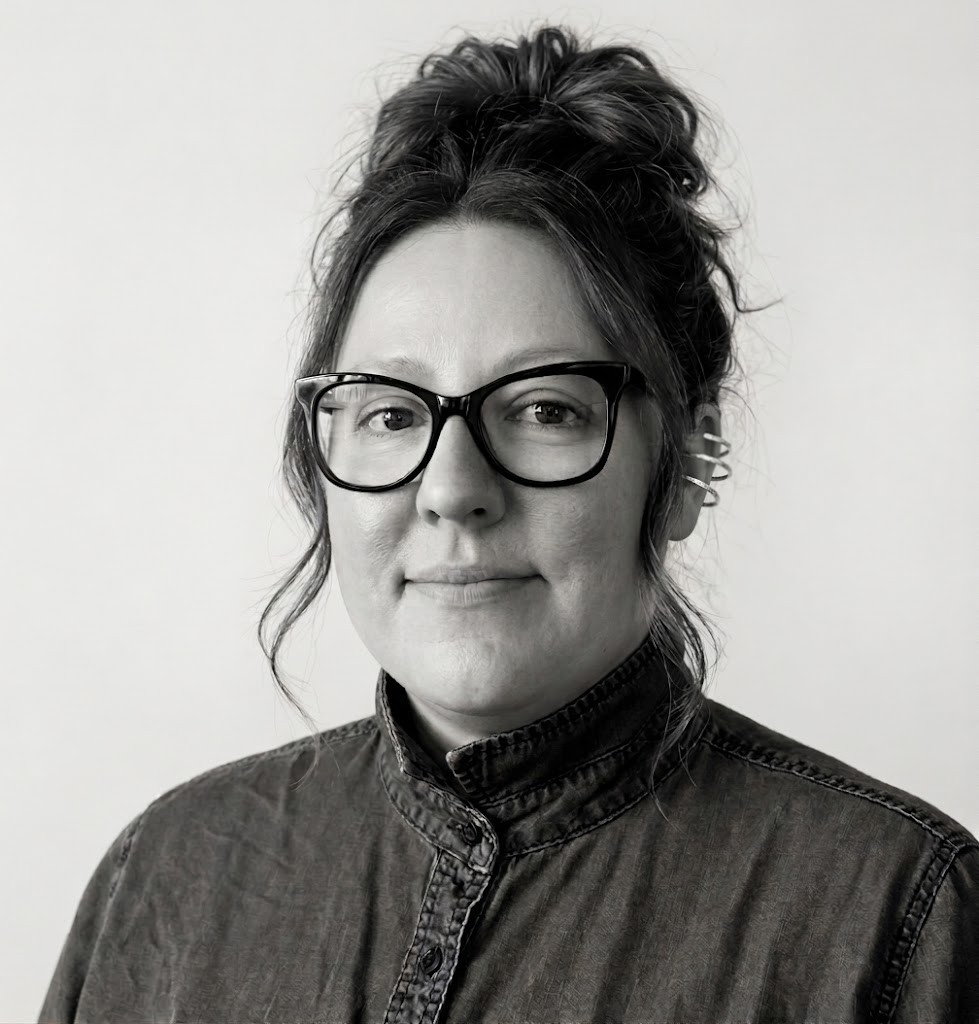
Jenny Savage is a Senior Visual Designer and creative thinker at frog, where she’s spent more than a decade bringing together design strategy, storytelling, systems thinking, facilitation and emerging AI capabilities. She specializes in turning complex ideas into clear, human-centered experiences and helping teams move from vision to action. Curious and playful by nature, Jenny loves exploring neurodiversity and sharing POVs, mental models and unexpected connections that help people see familiar problems differently. She’s equally at home facilitating workshops, shaping design systems and visual identities or making comics in her spare time.

Elizabeth tells design stories for frog. She first joined the New York studio in 2011, working on multidisciplinary teams to design award-winning products and services. Today, Elizabeth works out of the London studio on the global frog marketing team, leading editorial content.
She has written and edited hundreds of articles about design and technology, and has given talks on the role of content in a weird, digital world. Her work has been published in The Content Strategist, UNDO-Ordinary magazine and the book Alone Together: Tales of Sisterhood and Solitude in Latin America (Bogotá International Press).
Previously, Elizabeth was Communications Manager for UN OCHA’s Centre for Humanitarian Data in The Hague. She is a graduate of the Master’s Programme for Creative Writing at Birkbeck College, University of London.


We respect your privacy
We use Cookies to improve your experience on our website. They help us to improve site performance, present you relevant advertising and enable you to share content in social media. You may accept all Cookies, or choose to manage them individually. You can change your settings at any time by clicking Cookie Settings available in the footer of every page. For more information related to the Cookies, please visit our Cookie Policy.