
The AI-Empowered Marketer
AI-native marketing is the next destination
For decades, marketing has been a balancing act. On one side, there is the desire for broad reach. On the other, there is the ambition for one-to-one connections with customers.
Striking the right balance between these two goals has long felt just out of reach, with marketers often forced to compromise one for the other. With the rise of AI, we have finally reached the moment where personalized connection at scale is a real possibility.
Today’s bottlenecked content supply chain
Historically, marketers had to choose between scale and connection. Mass media like TV and print enabled broad reach, but personalization was limited. Digital innovation and social media brought new tools, making omnichannel distribution possible and expanding both reach and connection. Yet, in practice, reach usually won out. This was because the clarity of metrics and the abundance of tools made it easier to measure and achieve reach than to foster genuine connection.
The move to omnichannel engagement has also made the marketing landscape more fragmented. In this environment, marketing—which is at its core a creative discipline—can sometimes resemble more of a logistical operation. The pursuit of customer connection across multiple platforms, formats and audience segments has led to a complex content supply chain. And as a result, many marketers started to feel more like traffic controllers than creative connectors.
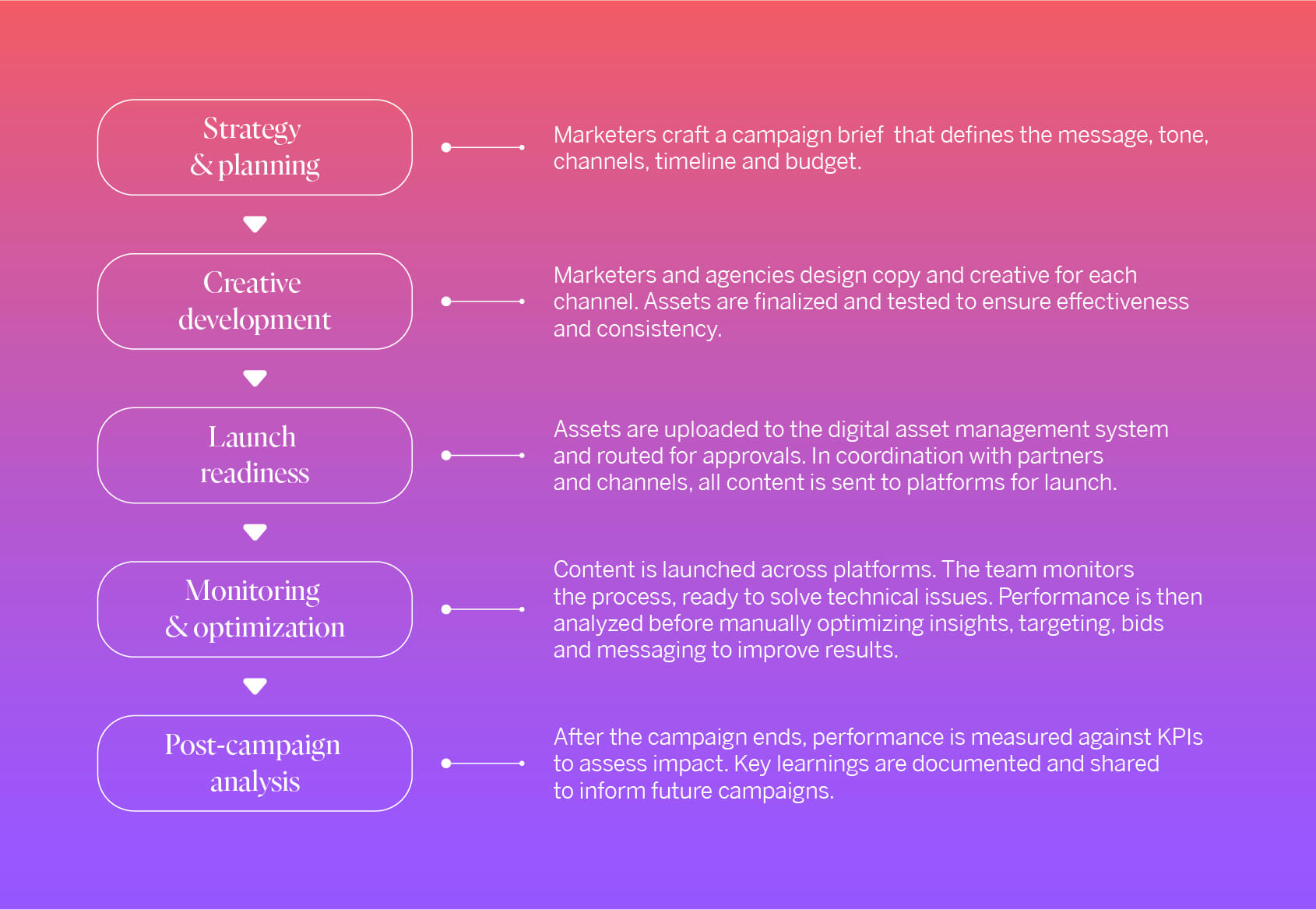
The stages of a content supply chain.
The traditional content supply chain has recurring pain points:
- Strategy and planning: Unclear objectives, misaligned expectations and vague audience definitions.
- Creative development: Slow approvals, manual asset reconfiguration and inconsistent quality.
- Launch readiness: Disjointed workflows, lost content and missed cultural moments.
- Monitoring and optimization: Poor tracking, slow optimization cycles and incomplete data.
- Post-campaign analysis: Difficulty interpreting performance data and applying learnings.
These pain points mean that marketers spend more time managing processes and orchestrating delivery than building meaningful connections. And it’s not just marketers that suffer. For brands, the complexity of the content supply chain causes missed growth and broken connections with consumers. Moreover, today’s consumers are quick to dismiss content that lacks relevance or authenticity. Personalization efforts often fall flat as consumers have learned to overlook current tactics such as reminders of what they have left in their shopping carts, their first names being included in body copy and suggestions based on their recent Google searches.
With these challenges in mind, it’s no surprise that a new frog and Capgemini Research Institute CMO insights report shows that only 18% of organizations strongly believe they successfully personalize customer interactions to boost outcomes, while 31% of marketers are fully satisfied with their ability to unify customer data sources (Salesforce State of Marketing Report 9th Edition). The content supply chain has become a content bottleneck.
Until we can reduce the time spent managing the content supply chain, marketers will remain constrained by human capacity. It is AI that can free marketers to focus on strategy and storytelling.
The AI-enabled content supply chain
AI will not replace marketers. Human intuition will continue to drive the craft of marketing forward, but AI will be an essential tool to dynamically generate and manage campaigns, content and insights—offering marketers even greater abilities to build personalized connection at scale.
Marketers can finally scale their messaging 1-to-1 with their audience, while benefiting from all the automation and speed AI provides. Marketers will no longer have to spend their time trying to manually pore over data and optimize campaigns or struggle with approvals or briefs. AI will also play a key role in orchestration, helping marketers save time by streamlining complex, siloed ecosystems and eliminating the need to manually connect fragmented systems.
Marketers will have AI as an assisting tool to streamline campaign optimization, based on real-time, performance-based results. AI shifts marketers time back to high value tasks. This helps solve solve reach (how, when and where), allowing marketers to focus on connection (what to say, to whom and why).
The concept of the AI-empowered marketer will grow and AI-enabled content supply chains will see five new marketing paradigms unlocked.
Marketers will be able to rapidly bring their ideas to life and their bandwidth with augmented creative and content creation, powered by human creativity.
Autonomous AI optimization will help craft dynamic campaigns, allowing brands to play an active role in the prevailing cultural zeitgeist, moving away from static and slow-moving campaigns that miss moments that matter.
The complexity of the content supply chain and manual management will be replaced by AI-powered workflow orchestration, helping teams automate repetitive steps and connect dots between their work.
AI makes measurement proactive, continuous and actionable. Marketers gain real-time visibility into performance and predictive insights to guide decisions.
As consumers adopt AI agents to filter and interact on their behalf, marketers must design for both human and machine touchpoints—earning representation in ambient systems, voice interfaces and mixed-reality environments.
These five new paradigms drive real results, boosting both business performance and marketer satisfaction:
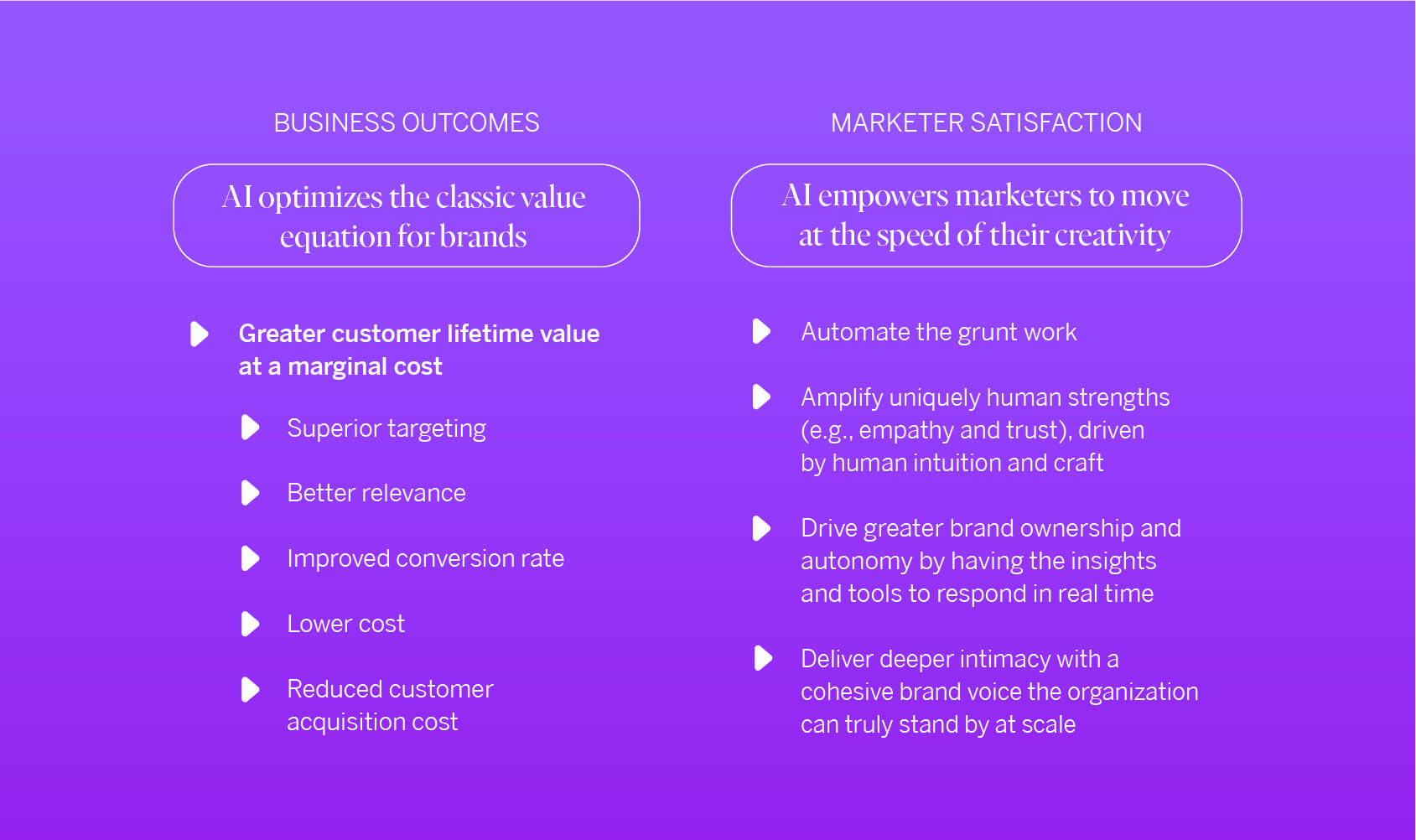
Marketing in an AI future
Agentic AI—autonomous agents that act on behalf of brands and consumers—takes the transformation of marketing even further. With agentic AI, marketers will not only be offered the chance to get back to creativity. They will also be required to work at their very best. They will be tasked with standing out as brand stewards, more so than ever before.
We see the next-generation marketer as a multi-faceted individual, opening new pathways to develop their skills and strategies. The AI-enabled marketer of the future will be a:
- Creative orchestrator, using AI to further inspiration and prolific content
- Cultural operator, considering how the brand will keep pace with the speed of culture
- System conductor, designing clear rules and escalation points for team collaboration with AI
- Insight interrogator, making sense of data alongside AI to stay competitive
- Experience architect, harnessing large language models to uplift the brand and stay relevant in the mind of the consumer
Marketers must evolve alongside their audience
Much like marketers, consumers are navigating a new buying landscape dominated by social commerce, AI, zero-click search and the next innovation just over the horizon. Disruption risks destroying the loyalty that marketers have worked so hard to build, but the five new paradigms offer a pathway to retain—and hopefully increase—the bond with consumers.
With the right support, marketers can bring all the pieces together to deliver a cohesive brand voice with greater connection and reach than ever before. The future will be won by marketers who embrace these new paradigms and evolve alongside their consumers.
And what does this AI-empowered marketing mean for consumers? It means they can expect a consistent stream of authentic content from the brands they love. Content that is increasingly relevant and engaging. Most importantly, the content should be trustworthy, helping to build lasting confidence in the brand.
The dawn of a new marketing era
At frog, we are always thinking about the ways AI will give us more power to achieve our goals, meet greater levels of demand and resonate more with the world. While we considered the five new paradigms for the AI-enabled marketer, we also explored how marketing teams can make these a reality for their people. For us, this a journey in three broad steps, from exploring to activating and finally, to scaling.
It starts by asking the right questions:
- Marketing strategy: What does the AI future mean for our brand and marketing?
- Proof of value: I’m intrigued, but can this actually deliver value?
- Defining what’s next: I want to do this – how can we make it work for our brand?
- Operating at scale: How do I apply this to everything?
The mass production of print, the advent of the radio, television and the dot-com era all brought us greater levels of social and cultural interaction. AI is just another step in that process and marketers have always risen to harness those evolutions in technology to alter the creative lens and find that balance between reach and connection. And now, a new era of marketing begins and it will be the AI-enabled marketer who will write the next chapter.

Ed leads frog’s CX Transformation team in North America, focusing on transforming marketing, customer experience, and bringing AI-enabled products to market. He brings deep experience enabling new capabilities at enterprise scale, across sectors. Ed’s outcome-driven approach helps clients modernize how teams operate, adopt AI responsibly, and unlock measurable commercial impact.

Megan is a strategist and researcher focused on driving customer experience transformation. With a deep background in the social sciences and systems thinking, she’s known for connecting the dots between emerging trends and timeless human behavior to design innovative strategies for what comes next. Megan’s facilitation talents ensure that everyone’s voice is heard during complex change initiatives.

Kate is a Manager at frog in New York City, with expertise in luxury fashion and retail. As part of the Customer Transformation team, Kate has helped Global Fortune 500 clients design AI-enabled, customer-centric omni strategies that strengthen long-term loyalty. Prior to frog, Kate spent over 5 years in the fashion industry and earned her MBA from Columbia Business School.

Adele is an Associate Consultant in the Customer Transformation practice in North America. Her work centers around marketing, content supply chain, and integrating AI responsibly to make customer experiences more accessible and engaging.


We respect your privacy
We use Cookies to improve your experience on our website. They help us to improve site performance, present you relevant advertising and enable you to share content in social media. You may accept all Cookies, or choose to manage them individually. You can change your settings at any time by clicking Cookie Settings available in the footer of every page. For more information related to the Cookies, please visit our Cookie Policy.