
Design Mind frogcast Ep.59 – Live from Milan Design Week
On this episode of the Design Mind frogcast, we ask: how is the physicality of AI expanding into our lives?
From eyewear to self-driving cars, AI-powered products of all sizes are increasingly making their way into our worlds. What can we do to ensure we welcome robotics into human spaces in mindful, respect ways? And could these intelligent objects set us on the path to finally becoming superhuman?
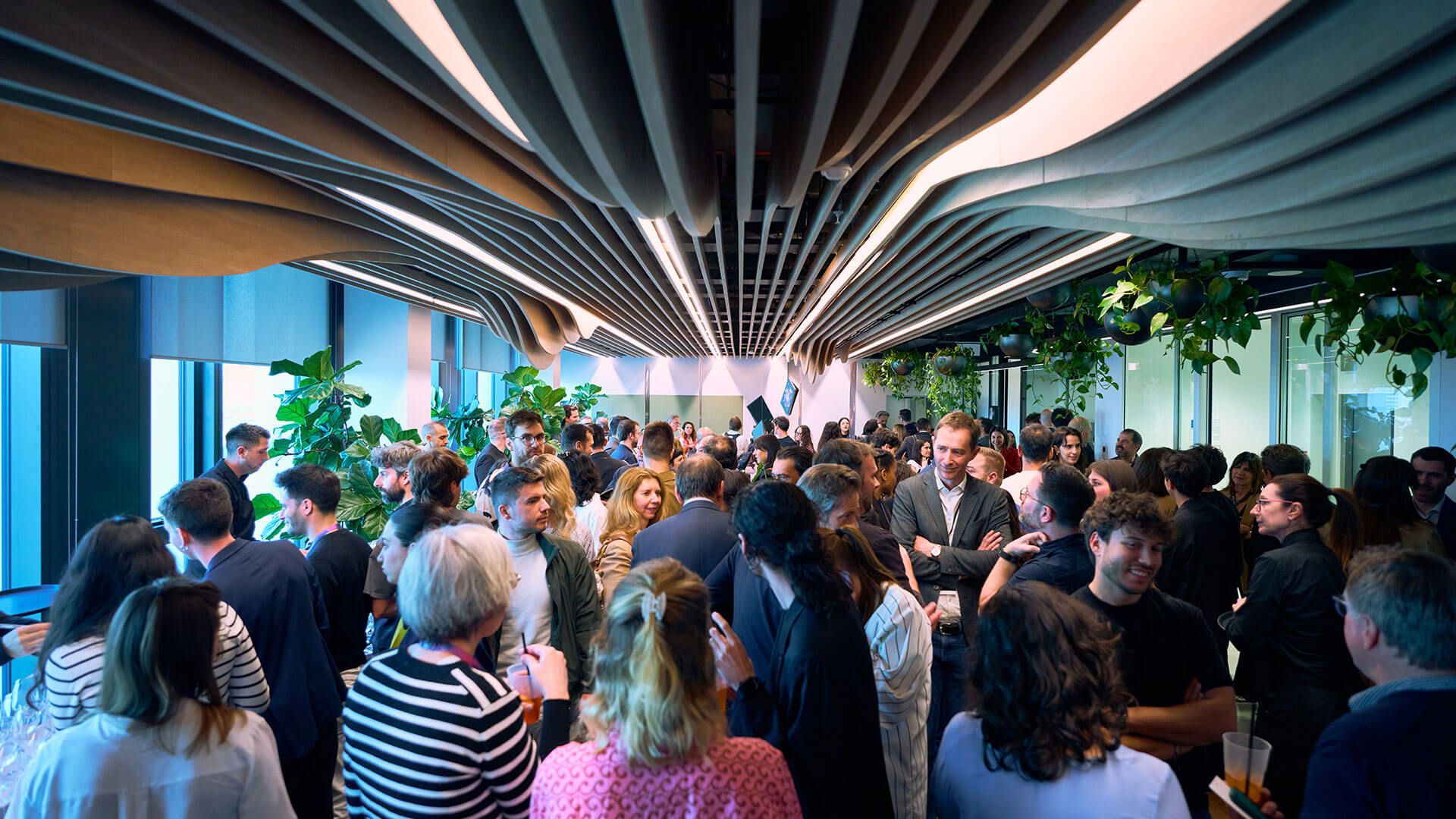
Live from our Milan frog studio during Milan Design Week 2026, join a panel of experts as they share insights into this fascinating, fast-developing area.
Listen to the podcast episode and watch the full video below. You can also find the Design Mind frogcast on Apple Podcasts, Spotify and anywhere you listen to podcasts.
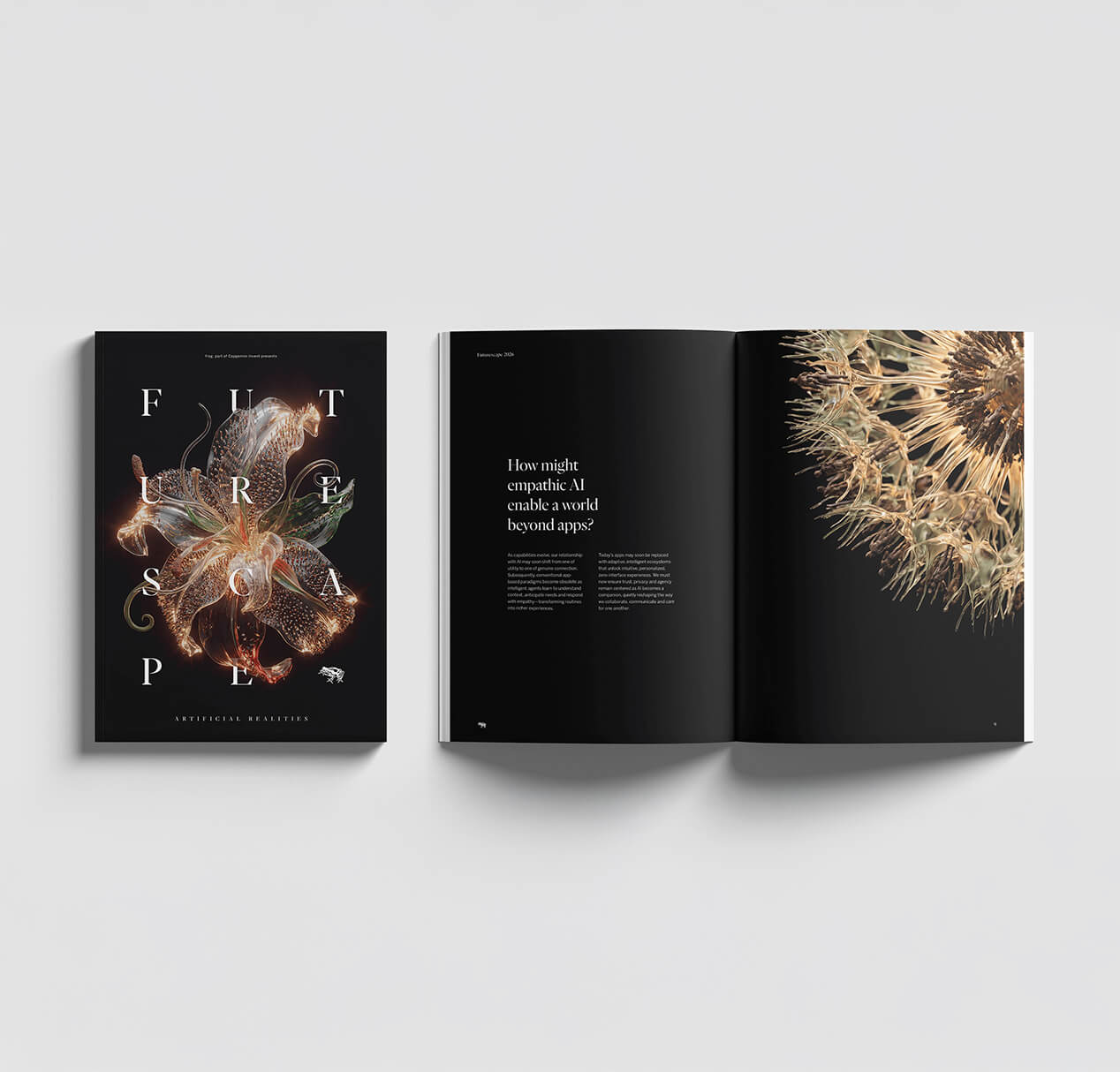
Want to go deeper into designing tomorrow’s world? Download frog’s latest Futurescape report ‘Artificial Realities.’
Episode Transcript:
Design Mind frogcast
Episode 59: Live from Milan Design Week
Guests: Chiara Diana, Chief Design Officer, frog; Matteo Battiston, Chief Design Officer, EssilorLuxottica; Massimo Banzi, Founder, SuperModerno, Co-founder, Arduino; Inna Lobel, Head of Industrial Design, frog; Tim Ensor, Director of Artificial Intelligence at Cambridge Consultants
[00:00:03] Elizabeth Wood: Welcome to the Design Mind frogcast. Each episode, we go behind the scenes to meet the people designing what’s next in the world of products, services and experiences, both here at frog and far, far outside the pond. I’m Elizabeth Wood.
Today on our show, we’re talking about physical AI and the future of human-centered embodied intelligence. To do this, we take you live to the frog studio in Milan, Italy, during the recent Milan Design Week, one of the world’s leading events for creativity, technology and craft. In a panel discussion, we’re joined by Chiara Diana, Chief Design Officer at frog, Matteo Battiston, Chief Design Officer at EssilorLuxottica, Massimo Banzi, Co-founder of Arduino, Inna Lobel, Head of Industrial Design at frog, and Tim Ensor, Director of Artificial Intelligence at Cambridge Consultants, part of Capgemini Invent. You’ll hear their perspectives on overcoming the hype, designing for privacy and the industrial applications of robots. We take you to the panel now.
[00:01:04] Chiara Diana: Good evening everyone. Welcome to frog. It’s a pleasure to see both some familiar faces, but also some that are new. I mean, it’s clients, it’s practitioners, it’s some colleagues that came from other studios worldwide. And it’s very special in this week that it is the Milan Design Week. I think it’s quite a special moment to be inspired and discuss about the intersection of creativity and innovation. So I’m Chiara Diana. For those that don’t know me, I’m Global Head of Design at frog, which is the experience and business reinvention brand that is part of Capgemini. And I have the pleasure to lead our frog Global Innovation Team that is actually based here in this office in Milano, right on the other side of the of the floor.
[00:01:52] Chiara Diana: Tonight, we welcome you into our Futurescape. Futurescape is our continuous, ongoing platform for research. What we do with our frogs, globally, with their inspiration, we look for the weak signals. We look for the weak signals at the intersection of science, technology and obviously design to start identifying what could be path forward, and we use them to shape trajectories that are more provocations for collective reflections than in defining exactly what the future should be. But it’s also a call to action for us to reflect on what is our agency and role in shaping this future forward. A lot of that is about this new human-AI chemistry: how humans and AI are starting to coexist, starting to collaborate and sometimes collide, in shaping new realities that were really not possible years or even months ago. And as part of that, an angle which is transformative is the fact that intelligence is starting to be embedded in the world surrounding us, in the objects, in the spaces, transforming the way in which we interact and relate with them and between us as human beings.
[00:03:10] Chiara Diana: So the question, in a way, becomes on how we design for that, and that’s going to be the topic of the conversation tonight. So designing for physical intelligence, and even starting maybe a bit back on what even physical intelligence is as maybe there are different opinions. I cannot be more excited for the panel tonight, as I have an exceptional group of speakers that join me and said yes when I asked them to join this conversation, friends and colleagues, bringing definitely different perspectives. So I welcome them on stage one by one, and share with me welcoming them.
[00:03:45] Chiara Diana: Tim Ensor, first, please join me here. Tim is the director of artificial intelligence at Cambridge Consultants. He is really working on understanding how that novel research in the space of artificial intelligence can be brought back into product and services and solutions that we can really practice.
[00:04:08] Chiara Diana: Second, I’ll invite Massimo Banzi. Massimo is founder of Super Moderno, has been co-founder of Arduino, and with that, enabling many of us as designers and makers to really start, you know, making things happen for real before they were even possible.
[00:04:25] Chiara Diana: Third, Inna Lobel from our New York studio. She’s leading industrial design in our North America team, but most of all, among others, also with her Nome project she’s leading the way in which we think about designing for robotics. A bit of debate will be today on, is robotics, physical intelligence? What else? But definitely, that’s an interesting perspective.
[00:04:46] Chiara Diana: And last but not least, Matteo Battiston, Chief Design Officer EssilorLuxottica, whose work on AI smart eyewear is really leading the frontiers of what it means to bring physical intelligence to scale. So I’m super excited. Thanks for joining me in this conversation today. I want to start with a warming up question for all of us. So we were debating this before. So when we think about physical intelligence, I tend intuitionally to think of these spectacular demos that we get back from CES where you see humanoid robotics that are crawling or dancing or even loading the dishwasher, which is definitely, maybe we feel more as a value gain. But is that the full story? Is that the place where people will feel physical intelligence first? So the question, the warm up question, and I will go in the round, will be how what do you see as something, as a tangible, concrete manifestation of physical intelligence today? And what you think is overhyped?
[00:05:47] Tim Ensor: Hi Chiara, thank you very much. This is a very exciting panel. I’m looking forward to this discussion as well. So for me, first of all, physical intelligence is a branch of AI where we can have machines and AI able to understand the physical world in a way that they’ve not been able to to date. And for me, the area we see that right now is us all enjoying increasingly low cost fulfillment of internet orders. Because behind the scenes, there are increasing armies of robots operating warehouses, which are a hotbed of innovation for allowing machines to understand the world in more intelligent ways. We’re seeing that right now, and that is an area which will continue to to emerge and innovate in secret. Did you want to hype one as well?
[00:06:24] Chiara Diana: As you like.
[00:06:24] Tim Ensor: I think you’ve already said it. So we’ve seen an awful lot of exciting back flipping robots and robots going around cleaning up our homes after us. I think that’s gonna be way off.
[00:06:33] Chiara Diana: So you’re saying that the ones which is more concrete is the one that we don’t see.
[00:06:36] Tim Ensor: Today? Yes, that’s right.
[00:06:37] Massimo Banzi: Well, I think one of the probably most interesting application for me is when you look at sensors. So now that we can use AI with sensors, we can from very basic information, we can extract a lot of understanding about the world. And also, there are AI models that the current AI models that we all use are currently mostly working on words, on text, but the new models, they are designed to understand the physical world. And I think that combination of sensing the world and understanding it, it’s probably one of the interesting things I’m most interested in.
[00:07:10] Chiara Diana: And hold that thought for some minutes, because that’s definitely one topic that we want to expand more, this topic of how do we understand the space around. Inna?
[00:07:20] Inna Lobel: I think an interesting application of physical AI has been the self-driving cars and Waymo and some of the kind of transportation robots that we see in the US. It’s been really wonderful to see them move around the streets, and how they can signal the intent, how they allow us to interact in these new ways. The hype, I think I would agree, is the back flipping robots.
[00:07:45] Matteo Battiston: Well, I think the question is pretty wide. So we have been trained in defining intelligence as something that is very human, and so even when it becomes synthetic, when it becomes artificial, I think it has to keep a layer of humanity. So I don’t believe in an intelligence, physical intelligence, that is here to be instead of humans, but with humans. So this is, I think, the purpose. That’s why I think there is a little bit of a misconception. So there’s probably where we can start debating about. I don’t think this will have the shape of robots that will make things instead of us, but quietly blending into life of people with products that we really accept. So that’s, I think, the best way for physical intelligence to really blend in our lives. So I believe more in small and hidden products than big humanoids that are here to replace us.
[00:08:41] Chiara Diana: Personally, I would agree. I don’t know if as a moderator, I should be neutral, or I can express an opinion, but I think it’s definitely is about spectrum. But I think that the place where people will start to feel it first is this element of agency that is starting to infuse into our everyday life and everyday objects. But in a way, is a spectrum, right? So on one side, you were speaking about dispatching goods. I think Amazon was just announcing that they did a one millionth robot that is playing in that space. On the other side, you have these AI that is infusing all the hair dryers that you try to buy now. So if you go on Amazon, all the hair dryers have an element of artificial intelligence into that. So definitely is a spectrum.
The CEO of Nvidia was saying that the “moment” for physical intelligence, or physical AI, is now. So why? I mean, what is happening now that is different from the previous waves? What is making it being a turning point that we should consider that seriously? Tim, first of all, from an engineering perspective, is this something that is really changing, or is another moment of just buzz?
[00:09:49] Tim Ensor: Yeah, I think Massimo was touching on this in his answer a minute ago, as is often the way, when you see these steps forward in capability, there’s a number of threads which are coming together. I think the most interesting one is the emergence of different classes of AI models, which are blending together an understanding of the visual scene that they’re looking at, the verbal description of that scene, or somebody asking a question about that scene, but also then including in that an element of action or reaction. There are new models emerging which bring all of those together. And that is the foundation of what we’re seeing in the new robotics capability.
Alongside that, we’ve seen the increasing importance of simulation capability, because, as we understand, we can’t train these models on words and images from the internet. We have to train them on an experience of interacting with an environment. Now the real world is complex and messy and in some cases dangerous and expensive if you’re going to train a robot. So training these actions in simulation is becoming increasingly important, and the quality of the simulations we’re working with now can be made so lifelike that when you train an AI model in a simulator and then you deploy it into a real product, it behaves in the way you expect it to, as opposed to tripping over the differences between the simulator and the real world. So that simulation capability is getting to the point where we’re suddenly able to get improvement in performance from robotic systems as well.
And I think the last one is on the hardware. And I think we’ll talk about miniaturization and how you bring different hardware capabilities together, but the ability of new compute chips to run these heavyweight models, to control robots in collaboration with improvements in motor technology and battery technology and sensing technology, all of those are coming together to the fact that we’re now seeing these step changes in what you can achieve with machines interacting intelligently with the physical world and the people around them.
[00:11:35] Chiara Diana: The moment is now not because of one thing. The moment is now because there are a series of things that are happening at the same moment and together are enabling this new even scale.
[00:11:46] Tim Ensor: Yeah, no, that’s exactly right. With any new emergence of technology, it can appear simple. So a lot of the YouTube videos that we’ve seen over the last year have largely been either robot machines, which have been following a pre-recorded script, or they’ve got a puppeteer somewhere in the background who’s a human directing them. And to try and understand how and where the challenges are, over the last year or so, at least a year, my team have been working in a lab with a couple of humanoids, where we’ve taken them apart, put them back together, change the sensor set, learn how you train them, learn how you get them to do useful work, to really get under the skin of where is the technology curve moving? How fast is it moving? And how do we work out where the real areas of value are?
[00:12:21] Chiara Diana: Thanks, Tim. And I mean, if we think on one side, the moment is now because technology seems to be more ready than before. On the other side, it seems that also people are a little bit more ready than before. I think we heard in the EssilorLuxottica report, if I put it right, that 7 million AI eyewear have been sold in 2025 so that means that there is demand. So why, Matteo, you think that there is demand now, and why eyewear have been the one element that has been able to bring physical intelligence into the consumer space?
[00:12:55] Matteo Battiston: That resonates with the kind of sweet spot that we were touching. So technology is ready, miniaturization is close, but there is something more. So people have awareness that we can empower them with something that is little bit different from what they were used to. It’s not the first time, if we think about it. So the very first branded product if we speak about glasses was back in the 80s. It was a medical device that then was turned into something that was an identity piece. So we changed the meaning of technology somehow. We are making the same leap in order to convince people that the moment is ready. How do you work with that? You work on trust. So that’s why we were one of the first doing AI glasses, we were one of the first doing smart glasses. Probably we have been the first thinking that those should have been products that people would have been confident wearing. And then it’s about wearing the product you are close to that somehow help you defining your identity and the way the world sees you, but with another layer that is really empowering in a different way. So that I think is the sweet spot which resonates with awareness of technology and scale, of course. So that was the fortunate angle that we try to create.
[00:14:13] Chiara Diana: So I’ll go off script for a moment, just because your answer triggered something in my mind. Do you think that as the one of the drivers for the adoption is that you have been intersecting a sort of desire for humans to be super humans in a way?
[00:14:28] Matteo Battiston: Maybe. So for sure not humanoids, just normal people with the glasses they love. That’s why we started with icons. Once again, it’s related to trust. You trust the iconic product that you always have been wearing. But I think a layer that was a kind of a plus—that is a that is a kind of a competition that products make with your attention. And if you think about the real estate that we are wearing when we wear this part, which is a part that is not for free. So putting a product on your face, it’s not like putting on your wrist or in your pocket. So this is where your identity starts. But it’s also close to your senses. It’s so close to your vision. It’s close to your ears, it’s close to the possibility to speak and to communicate. So the idea that you can compete a little bit less with your attention, for example, in looking at a wrist or raising a telephone, that is, that was a strong benefit, and that is just the beginning of something that can be bigger and bigger than that.
[00:15:25] Chiara Diana: We spoke about, you know, this is not the end. This is just the first step. It’s a longer trajectory of transformation and potential. Massimo, with Arduino, you brought physical computing to many people. You were enabling many people us in the first place, makers and designers, to start prototyping things that were not there yet. Where is the next wave of physical intelligence going? What are people prototyping now that we don’t know yet?
[00:15:50] Matteo Battiston: One of the things that’s happening is that if you look at the history of technology, there was some ideas before, there is a technology that’s available, and now technology is catching up. So now you start to get very powerful processors. They use less and less power, so that you can run complex models, also on very cheap hardware. So when I started running the first machine learning models on little processors, you could do very, very basic things. Now you can run the equivalent of on a computer that can see the size of a book, and it will be the size of a tiny cube at some point. And I think this is very, very important because one of the things that I wanted everyone to be aware of is that physical intelligence is great. You see all these things that are beautiful, but it’s an incredible privacy nightmare, because every time you use an AI that runs somewhere else, they are using your data. They basically feed themselves on your data. They know everything that you do. And you pay. You pay to be surveilled.
So I think one of the things in the future, this concept of local AI, it’s going to be an incredible moment. I’m already running my own AI server, so I don’t have to go, I think, to the cloud. But I think in the future, you will be able to have a tiny server somewhere in your house that run your own AI, that one is the next thing I’m really looking forward to. And yes, obviously these new AI models that understand the physical world are going to be incredibly important because understanding the physical world through language, it’s not exactly the future, but you know, one of the fathers of AI is looking at this new models that really start from an understanding of the physical world, and they can actually learn. So the robot can fall down three, four times, and then suddenly start to learn by itself. Why am I falling? Can I stop falling? Current models don’t really do that. So we could be talking for all, but the takeaway: privacy, be careful.
[00:17:58] Chiara Diana: So maybe shifting gears more to the role of design into that and how design is changing. With the Nome project, Inna, you have been exploring a lot about how do we understand, we are understood, and then we build relationships. Behaviors are becoming the interface by which we interact and understand these objects that are becoming intelligent. What’s your take and perspective on it?
[00:18:20] Inna Lobel: Yeah, I think that’s one of the things that’s been really interesting for us to think through, is kind of, how do we actually live with these objects? How do we want to bring them into our houses? Into our like human spaces? And how do we make sure that we’re kind of both creating and preserving the right aspects of our culture? So with Nome, this is an R&D project for us, where we’re thinking about, how do we bring robotics into the home. But really it’s about, how do we bring robotics into human spaces? And one of the things that we did there was, first, just map out, what are some of the social interactions, what are some of the ways that we use our homes, and where do we want something that augments us? What would it mean for it to be part of the fabric there? And so it’s interesting. I think behavior is one critical interface, and there’s actually two interfaces, because behavior is also empowered and created through the form that it has. So we looked at those things together and really being mindful of, you know, how does this object signal to us? How do we signal to it? What are the right moments to have it kind of come into our spaces? Where should it stay back and then really thinking about the ways that we communicate with each other, and trying to tease out which ones of those might we bring to this platform so that it can be more legible? So that we can understand intentionality, and I think it’s going to really go both ways.
[00:19:49] Chiara Diana: And you mentioned, I mean these signals, and this interpretation of the signals, and therefore the intent right on both sides. Because in the moment in which those entities start to get agency—and this is in the physical space, but I think in the digital applies similarly—how do you anticipate what is going to happen, which plays in an element of trust as well? So the idea that you can predict what is going to happen, reaffirming your interpretation of reality. This human-machine understanding is becoming key. We spoke about the new models that are starting to interpret the human space, the physical space, but it’s also about the human and the machine itself. Tim, what is changing from an engineering perspective that is enabling this interpretation to happen? I mean, can we code empathy in a way?
[00:20:37] Tim Ensor: It’s a really interesting and challenging space, I think, for me, for a product to respond in a way which is empathetic, somehow, without wishing to overload any of these words, it has to be able to react to the human in a way which understands the context that human is in and responds in a way which is in line with what they would expect. And this is quite hard for a machine because humans are very complex entities, as we all know. But we looked to this about three years ago, four years ago, we started a team specifically called Human-Machine Understanding, where we were bringing together psychologists and behavioral scientists with our AI engineers and our computer scientists to try and kind of grapple with this particular area. Because we could see that this was going to be a challenge that as we embodied more AI into products we would all want and expect to be able to interact with them in more naturalistic ways. At its core, from an engineering perspective, it comes down to blending different ways of sensing the world around us in intelligent ways. And some of the work I mentioned on our robotic theme is relevant, but I think it carries across to any form factors. Where we’ve had an example where we’re blending sensors from image, putting those through a number of different algorithmic threads to be able to understand someone’s speech, be able to understand their gesture, be able to, from a view of the world, interpret a gesture as relevant to an object in the scene. We can identify the object and label it in association with the words from the human. And we can also survey the scene to kind of unpick ambiguity. So there’s a great video one of our researchers who’s leading this space having a conversation with the machine, where he says, “Can you move the cup over there?” And this location of the cup has to be identified over there being a reference to an object or a table, in this instance, has to be interpreted, and then the instruction gets played back again. But there’s also ambiguity because, actually, there’s two cups, so that the machine has to go, “Oh, actually, I need to solve this ambiguity first before I can understand how to respond effectively.” And it’s just kind of a little example of what the team have been doing to try and think about: how do you bring different interaction modalities, both visual and verbal, and in a way where the machine has an understanding itself of the scene and has to work through the thinking about what does the human mean from the instruction or the interaction they’ve given? And unpick that to ensure that they can respond in the most empathetic way. So it’s a really, really rich and exciting area, which I would say we’re just at the beginning of. But I think it’s these technology pieces which enable us to design behaviors on top of them.
[00:22:54] Chiara Diana: While I believe that conversational AI is fantastic, and all this kind of chat interactions with all the dimensions of life are definitely opening up the territory for novelty, but it feels like, in some moments, a regression to a way of expressing and interacting that is very intense and time consuming and very difficult to express the totality of your intentions and even emotions. I was hearing this podcast with the CEO of Airbnb, and they were discussing about, you know, disintermediation and will have everything happen to an agent. And he was saying, but try to book the apartment for your next vacation just in a verbal conversation with a chatbot—it will take ages and forever, and you’ll probably not get it right in the first place. So this idea of enabling a multi-dimensional, multimodal understanding of reality, to me, is really foundational to you know, enabling what is what is possible next.
[00:23:48] Tim Ensor: I completely agree, and I think the space we’re at now is trying to work out, how do we give AI machines enough embodied context to be able to respond appropriately? And as humans, we build that context up over our entire lives of interaction. And at the moment, machines don’t have that ability. But I think this question about how do we create data models which allow a machine to access the context of relationships between people, relationships between a person now and events in their past, relationships between the group of people. And all of this is extraordinarily rich context, but is necessary for us all as humans to respond appropriately to each other. And I think that is the next challenge for us to get machines to respond appropriately—is to be able to collect and model that data in such a way that a machine has access to it and can then give the kind of appropriate answers. Because I can 100% agree with you, prompt engineering should not be a thing, but at the moment, it is a thing because we have to communicate with large language models in this way.
[00:24:45] Chiara Diana: You are saying that it’s important for the machines and this intelligence to get the richest possible understanding of the reality surrounding them. I mean, eyewear is there, right? They are this layering between perception and the world around us, the world around us and us, and how we can then act on it. So, Matteo, I’m keen to hear your perspective on what Tim shared, but also how in the moment in which you’re there and continuously, I mean, how you bear with that responsibility. How do you balance discreetness? And then when is the right moment to actually act?
[00:25:20] Matteo Battiston: I think it’s, I go back to what Tim was saying, and I think in this room, in a design firm, it’s happening something that is we need to stop for a while and think. It’s a new beginning where we are designing new objects without thinking about performances and functionalities. So the major words that we have been using is culture and behaviors, which is beautiful. So we are designing something that is really new to people, and it’s something that we can design starting with the way that we really interact with the world. And this is why we feel that working, for example, in this space. It’s a kind of a quintessential thing because here’s where the large majority of things that happens to us start. We see them, we sense them, we hear them. And yes, there is a there is a strong responsibility when you build, and you start building and designing those behaviors, because we need care. We need care of different aspects, we need care about intention when you load a new kind of intelligence to a human body. And so we need to be sure that the intention of the gesture that you are making are the right ones. And so those things can do a lot of things, you have to do the right one at that moment. This is the first one.
The second one is about being respectful of cognitive load. So we are doing things towards the world, but we are receiving a lot of data. You can be informed of things that are happening with information that are placed in the right place in the real world. Are we used to that? So we have to get there in the in the right way, in order to augment humans, not to disturb our intention.
And the third layer of responsibility, which still deals with what Massimo was saying, is respect to the bystanders. So we are doing things that are having an effect on people that are around us. Creating behaviors and creating services and information that are clear to the bystanders, won’t solve at all what Massimo was saying, but they take it into consideration. In this fast conversation that we did before getting here on the stage, we were speaking about just one piece of technology. So if we think about a camera, for example, and we think about a camera in our garage, or we place it in our living room, or we place it in our face. We have three different way to think of that camera. So we have three different approaches, and maybe also some skeptical ones. In a garage it’s very simple. In my living room, what is happening? On my face, what can you see that I’m seeing? So that’s the responsibility we have when we design, taking care of privacy at the very beginning and at the core of every product, which I think it’s a layer that it’s not skippable when you start designing. It’s a first layer. So this is the first thing you design.
[00:28:13] Chiara Diana: We discussed a lot about before about compromises and constraints in the journey towards bringing, you know, this intelligence to scale. How do you deal in the moment in which you have these ambitions and priorities on trust and behavior, but on the other side, you have elements of constraints and compromises that needs to be made in order to meet the next milestone?
[00:28:37] Matteo Battiston: That’s the new skills of designers. So you don’t just deal with shapes and with materials. Anytime that we you make a choice, it’s a choice that is trading off with something else. You want two hours more function, and then you deal with two three millimeters on your face, or you want another function, and then you have to drop another one, or you have to add a lot of expense in terms of investment to have new batteries, new harvesting, new whatever. So it’s a complete and ongoing tradeoff between function and acceptability of people. Because, once again, and I’m just thinking about something that goes on our body, not always on a face. It’s your body. So you are not a carrier. So it’s a product that has to suit you. And so that’s a real challenge when we design. It’s a complete new set of know-how that a designer has to have, because the level every designer describes himself or herself like a curious person, the level of curiosity that you need to have has to go skyrocketing—because you have to deal with electricity, you have to deal with the connectors, you have to deal with magnetic powers. So, it’s not just about a ship that you move with a chassis around something, especially when it’s when you are in on such a complex real estate like on your face. So yes, it’s a complete trade off every minute.
[00:30:04] Chiara Diana: Massimo, you had a perspective on the constraints as a way, I mean, even as a matter for design. I mean, we live with tradeoffs. We design with constraints. What’s the role of constraints in designing? And specifically, when we think about intelligence getting physical?
[00:30:21] Massimo Banzi: Well, so I think one of the aspects of design is very interesting, is that the constraints, sometimes they make you very creative. The fact that you have to work around the constraint is actually what gives you sometimes ideas that are not conventional, because if you had all the money in the world and all the things in the world, you would, you know, when I made the first Arduino, my constraint was it had to cost 20 euros. So I had to take away everything—it was like the Model T Ford. It’s a product that still sells now, ridiculous. But one of the other constraints, to me is very important, as I teach interaction design. So the first constraint between multiple quotes should be human beings. So we do user-centered design. So for us, the wellbeing of the person that we are designing for should be one of the main constraints. Unless you’re designing bombs, that’s a different story. But for all the other products, the person should be at the center. And I always thought that even in technology, a lot of times when we try to design things and we have constraints, you mentioned it, you know, sometimes it’s power, you know, can you live with, like a bigger object for that tiny bit? So that those constraints, sometimes, they’re where you come up with the great idea, which I think it’s, it’s good. I love constraints. They make my life simpler.
[00:31:34] Chiara Diana: Do you think that then with these new layers that you were referring to, you know, these new dimensions, new variables that we need to consider, and this new curiosity that we need to have, do you think that the process of design needs to change compared to what we have today? If I think about the horizons of, or, speed of bringing an innovation to reality, if you think of a digital solution now, you can do that in a week in a few months ago, you can do that in three months. But if you think of a cycle of producing something, you know, physical object is completely another timeline. Shall we change our design process because of this new interplay?
[00:32:10] Massimo Banzi: Well, obviously your design process is going to change a little bit, because now the variables you have to look at. So when you’re designing a chair, there were a certain number of things you have to take care of, but if the chair starts to have a bunch of sensors, there is an AI, there’s a bunch of different constraints, obviously, the way you organize your work, the workflow, the people you need to bring in, the fact that you know, if I look at my students, obviously, many years ago, they were mostly concerned about some aspects of the project. Now, my students in the master of interaction design, they do AI, they use AI as a tool, but also they understand AI as a material for building something. The number of things they need to keep in their mind, and they need to create some kind of a coherent vision starts to, you know, increases quite a lot understanding what kind of sensing can we add to this thing so that it understands the world, it understands people? So I think the process becomes much more sophisticated. And when you’re making something physical, it’s ten times more complicated. Because, you know, in software, if your computer blows up, you go to Media World, you buy another one, it’s fine. But if you are building, you know, a very sophisticated piece of hardware, software, and your prototype blows up the night before you’re supposed to show it, which probably happened to you a few times? It’s not random that in the US, they say “hardware is hard.” It’s hard for a reason.
[00:33:36] Chiara Diana: Inna, how many objects have you broken before going live at the NVIDIA event?
[00:33:42] Inna Lobel: It definitely happens. Usually it works perfectly, until you have to show it, right?
[00:33:48] Chiara Diana: You have been experimenting a lot in this space. In frog as probably one of the most experimental. I mean, what can you bring?
[00:33:56] Inna Lobel: Yeah, I think, you know, one thing which is true is I feel like the fundamentals are really important. And that’s something that, you know, we always kind of come back to is: what is the context that we’re designing for? How do we prototype really quickly with cardboard so that we can get the ideas out and get a better sense for what to do? Because hardware is hard. Every iteration that you make takes a while to prototype, and I think we’re being really mindful of that right now with physical AI also, because now as the complexity of what we’re designing increases, making a prototype that works is also exponentially increasing. In order to build a simulation of something, the definition that you have to give to a hardware product, takes time to define in appropriate ways. So we’ve been experimenting with new formats, for example, leveraging VR, leveraging the gaming and Unity, and the types of kind of interactive media that exists to see, okay, well, maybe we can take physical AI and robotics, and before we do all of the hard work on the engineering side, we can start to interact with these systems in a digital way as a bridge to gaining confidence that, yes, that’s what we want to be doing. You know, this is the way we want to be interacting with it that kind of feeds back into what the sensor set is that we need. Really looking at ways that we can collapse the process, gain more confidence in what we’re doing, and build that bridge across the various parts of the design process.
[00:35:34] Chiara Diana: On the other side, Tim. When you when you look from outside, you think, these designers, they come with the ideas, but it’s never feasible. How are you thinking of the engineering process evolving in this context?
[00:35:45] Tim Ensor: We always value the multidisciplinary leader and the multidisciplinary team, and that system thinking is something which we have to grapple with every day. And we have our core as an engineering team, but we have some designers, and we work with the frog team a lot. So the breadth of what you need as a set of disciplines, I think is expanding. And the more complex the products that you’re building, the more complex and experience you’re trying to create, the more disciplines you need to be able to either have both in the team, and have in your mind.
Some really interesting examples that say, I come back to the robotics example because it’s something I’ve been working on for the last year with my team, but it’s also really interesting because of the richness of expression you can get. We chose humanoids as our experimental platform because they’re the most complex. You know, they have 26 degrees of freedom in their movement before you even get to the hands. And so that is really interesting. So a couple of design choices that we’ve seen recently. So Boston Dynamics new humanoid robot, they decided to make it have 360 degree rotation. So it can walk forwards, rotate its entire body 180 degrees and walk backwards without moving its legs around to walk backwards. Its head will rotate like an owl. So they’ve had engineering choices which have implications for the way people interact with it, and the way in which you the design space you’ve got to deal with. But then I also look at the things that Disney have done in their robotics, which they have been so deliberate in designing the personality. And it’s a personality as expressed through physicality of the of the device.
But what’s interesting about AI is its amazing capability to generalize, which means that you show it one example, you train it one thing, and it responds appropriately in an example you haven’t trained it for. And so what that means is those designers have had to deliberately create the personality for the robot moving in a certain way, but then in the real world, didn’t move in some other ways. And it’ll take the characteristics of how you’ve trained it for this thing and it will express it in a way you didn’t train it for. And so we’re getting all of these additional dimensions of building learning systems into products, which is a whole other way, I think, that the design community needs to be thinking about okay, I designed it for this, but my AI is going to generalize it in another way which I didn’t design it for. We may not have tested it for. And the AI will represent it in the way that it chooses to. So understanding how that AI system is built from the ground up is a is another dimension of design understanding.
[00:38:00] Inna Lobel: Yeah, I love that you use the word personality, because that’s what we’ve been thinking about as well. And kind of one of the things that we’ve been doing in designing these products that have motion, is right away thinking about the motion signature and building out kind of the character palette so that you can do something like that. And you start thinking about, what are the different ways we might want to interact with it, and how does that mean it’s going to kind of come to life in the systems? I think it’s such an interesting space.
[00:38:31] Tim Ensor: If I can build on that, it’s also really interesting that you have to be deliberate about the things you think are obvious. So I had a really interesting conversation with some of the guys at Boston Dynamics, and their first product was the dog robot, and they trained it to go and inspect something and come back again. But because they trained it for utility, it just walked forwards and it looks up and then it walked backwards, and everyone looked at wend “a dog doesn’t do that.” So the assumption that people bring because of the form factor you’ve used means that you need to go, well, people aren’t going to like that, not because it’s not following the utility of the job you’ve asked it to do, but because people have a preconception about the form factor and the personality you need to give it.
[00:39:04] Chiara Diana: I think we all feel a bit of this tension of being, you know, on the edge and, I mean, are we jumping, or are we not? We feel this tension every day, every announcement that we read, it’s a little bit more jumping into the unknown. But I think that’s the part that is very fascinating to me. It feels like, when we got the first wave of digital I started design at school for industrial design. It was not, you know, anything else. And these digital things started to come up, and it felt like we are writing something that is completely new and that was fascinating. Now I feel it’s another wave of like that. So we are jumping into something that is completely new, all to be written, all to be, you know, scribed. And I think that that’s because in this discourse, there is a role and an important role for design. So with this said, I thank you all. I thank you panelists for staying with me. Thanks so much, also for the conversations before. I thank you all for being with us. Stay with us little longer. So enjoy the exhibits. Some are a bit provocative on some of the topics that we covered. Get a drink. Keep connecting with people, and enjoy your time with frog. Thanks for coming.
[00:40:15] Elizabeth Wood: That’s our show. The Design Mind frogcast was brought to you by frog, a leading global creative consultancy that is part of Capgemini Invent. Check today’s show notes for transcripts and a link to download frog’s Futurescape report.
We really want to thank our guests and the team at frog Milan for sharing their insights from Milan Design Week.
We also want to thank you, dear listener. If you like what you heard, tell your friends. Rate and review to help others find us on Apple Podcasts and Spotify. And be sure to follow us wherever you listen to podcasts. Find lots more to think about from our global frog team at frog.co/designmind. That’s frog.co. Follow frog on X at @frogdesign and @frog_design on Instagram. And if you have any thoughts about the show, we’d love to hear from you. Reach out at frog.co/contact. Thanks for listening. Now go make your mark.

 Play video
Global design and innovation leader, Chiara brings over 20 years of experience shaping futureproof products and services for multinational organizations, with a sustained focus on healthcare since joining frog in 2010. Her work translates emerging technologies, human needs and regulatory complexity into experienceled, scalable healthcare innovation.
Today, as Chief Design Officer and Head of frog Innovation Team, she leads the growth of frog’s own design practice, shaping new capabilities, offerings and methods with teams worldwide.



Inna is a design and innovation leader focused on shaping next-generation products and experiences. She leads Industrial Design at frog across North America, shaping products, systems and experiences from pre-concept to launch. Her work turns new and emerging technologies into products people want and value, with a growing emphasis on robotics and physical AI.

Elizabeth tells design stories for frog. She first joined the New York studio in 2011, working on multidisciplinary teams to design award-winning products and services. Today, Elizabeth works out of the London studio on the global frog marketing team, leading editorial content.
She has written and edited hundreds of articles about design and technology, and has given talks on the role of content in a weird, digital world. Her work has been published in The Content Strategist, UNDO-Ordinary magazine and the book Alone Together: Tales of Sisterhood and Solitude in Latin America (Bogotá International Press).
Previously, Elizabeth was Communications Manager for UN OCHA’s Centre for Humanitarian Data in The Hague. She is a graduate of the Master’s Programme for Creative Writing at Birkbeck College, University of London.


We respect your privacy
We use Cookies to improve your experience on our website. They help us to improve site performance, present you relevant advertising and enable you to share content in social media. You may accept all Cookies, or choose to manage them individually. You can change your settings at any time by clicking Cookie Settings available in the footer of every page. For more information related to the Cookies, please visit our Cookie Policy.