
Design Mind frogcast Ep.58 – When Human Connection Meets AI
On this episode of the Design Mind frogcast we welcome Jess Leitch, Head of frog North America, to talk about how design is evolving in an AI-shaped world.
Jess traces her transition from consulting to experimentation-led design. She also discusses vibe coding, the opening up of creative tools and how AI is redefining brand relationships and business models.
Listen to the podcast episode and watch the full video below. You can also find the Design Mind frogcast on Apple Podcasts, Spotify and anywhere you listen to podcasts.
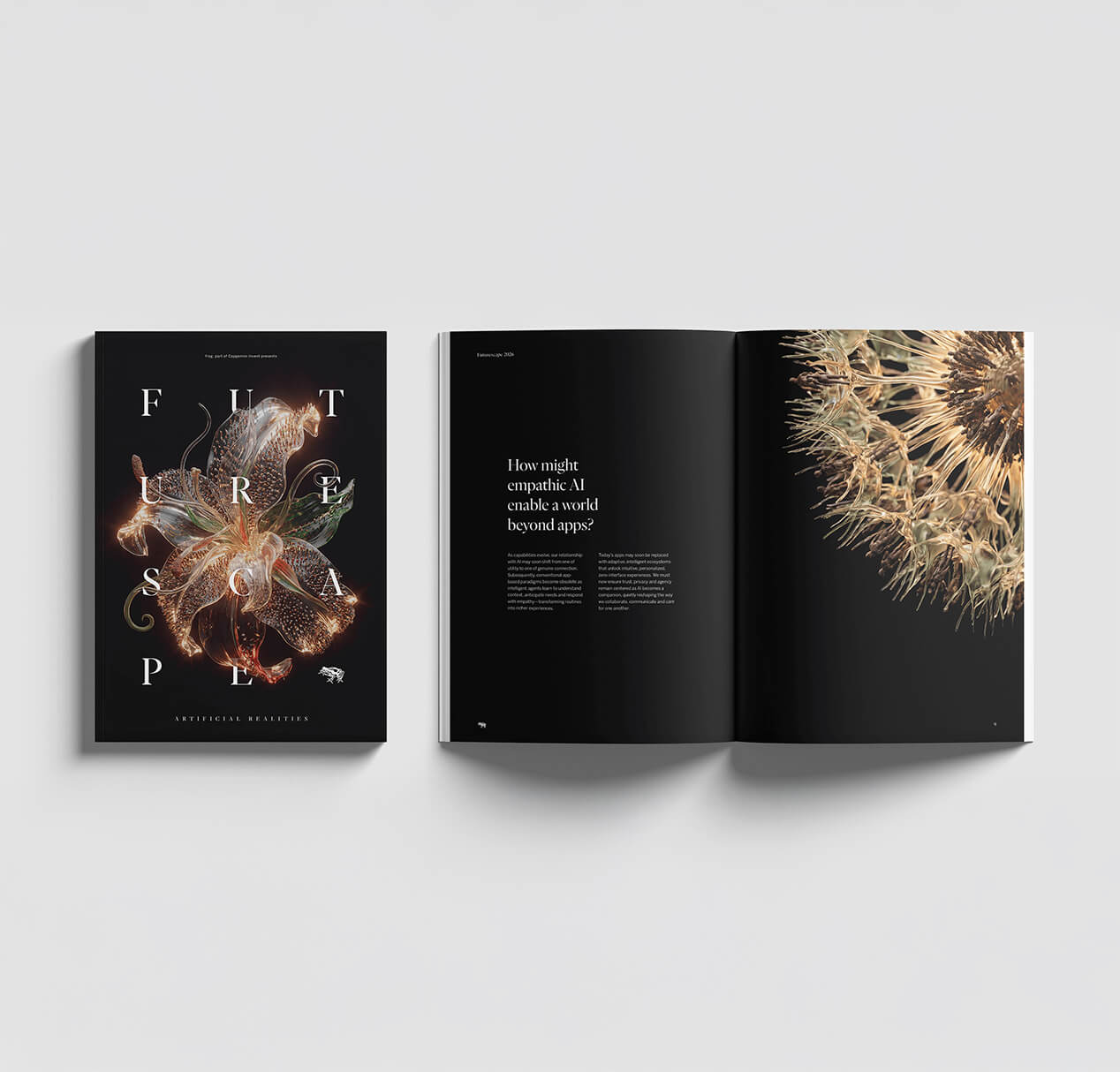
For more on the co-evolution between humans and AI download our latest frog Futurescape report ‘Artificial Realities.’
Episode Transcript:
Design Mind frogcast
Episode 58: When Human Connection Meets AI
Guest: Jess Leitch, Head of frog North America
[00:00:03] Elizabeth Wood: Welcome to the Design Mind frogcast. Each episode, we go behind the scenes to meet the people designing what’s next in the world of products, services and experiences, both here at frog and far, far outside the pond. I’m Elizabeth Wood.
[00:00:19] Elizabeth Wood: Today on our show, we’re talking about the role of design in a world increasingly impacted by AI. To do this, we’re joined by Jess Leitch, Head of frog North America. Jess shares her journey from traditional consulting to design leadership, driven by a desire to challenge assumptions and embrace experimentation. She also discusses the rise of vibe coding, open access to creative tools and how AI is reshaping brand interactions and business models.
[00:00:45] Elizabeth Wood: Jess also played an important role in this year’s frog Futurescape report titled ‘Artificial Realities,’ which explores 12 predictions and provocations on the future of human-AI chemistry. Here’s Jess now sharing more about how she’s using the report with clients and why it matters when it comes to developing business strategy.
[00:01:04] Jess Leitch: I think that it’s really tricky if you’re in a large organization, to take the time to think about what’s happening next year, let alone in the next five to 10 years. This report can help with that. I think that that is that’s hugely beneficial, and that’s been the way that we have been using it, and I’m bringing it to board meetings or meetings with C-suite to have conversations with people about: How do you think that this is going to apply? Like what of these scenarios feels relevant to you? And what of these, you know, potential futures, can you see impact in your business?
[00:01:38] Jess Leitch: People just don’t really get the opportunity to do that in these kind of quarterly reporting cycles that most businesses are in. So being able to take a moment and to stop and think about what those future scenarios could look like are just, it’s invaluable. And to do that with us, with the people who have been thinking about this and, you know, who are incredibly passionate about what some of these future scenarios could look like and with the implications of some of these scenarios playing out, I think is, is the best way to do it.
[00:02:06] Jess Leitch: My name is Jess Leitch and I’m the Head of frog in North America. So, I run all of the frog teams out of the US and Mexico.
[00:02:15] Jess Leitch: Originally I moved into design because I started my career in consulting, actually and I, I think I grew frustrated with the advice that we were giving to clients and the way that we were going into their organizations and applying our assumptions and looking for the answers to support the assumptions that we were making and I was looking for something that would make less assumptions, for a process, for a way of thinking that would be less assumptions-based and so design as a field really appealed to me for that reason. That we weren’t going to make assumptions about what someone would like or what would fill a need. We would actually go in and test that and experiment and we wouldn’t assume. We wouldn’t take a template from one organization and try and apply it to another. And I really loved that about design and so deliberately made a choice to move away from more traditional strategy consulting, and, you know, customer consulting, towards, you know, at the time, more design thinking. And I honestly never looked back. It’s an amazing tool for innovation. And it helps you to see things that you would never see otherwise. And I think that it is when combined with, you know, technology and the other tools or even sometimes combined with more traditional strategy methods, honestly. From a business model standpoint, I think that it is, it moves, it moves markets, industries and people forward.
[00:03:49] Elizabeth Wood: That shift away from an assumption based approach is one that many organizations are making, especially as they explore emerging technologies in a move toward experimentation driven strategies, the questions clients ask our frog teams have also started to change,
[00:04:03] Jess Leitch: I think at the moment, the top question that clients ask relates to AI and it’s coming from two ends of the spectrum. So at one end the question is, how can I use AI to improve the delivery of my services, so that I do a better job for my customers, so that I increase the capacity of my customer support teams, of my operations teams, of my delivery teams, so that I reduce the time to serve, so that I reduce the cost to serve. Can you tell me, throughout my journey, where I should be using AI to help me do better by my customers, do better by my organization. So, one end, we’re getting a lot of those kinds of requests for, you know, what the best tools are in AI, help me understand that and help me work out where I should be implementing that within my organization. And you know, we actually have some amazing case studies already where we have increased efficiency by 1,000% from some of the recommendations that we’ve made that our clients have gone ahead and implemented.
[00:05:11] Jess Leitch: And then at the other end, we’re getting questions around how is AI going to change the way that my organization interacts with customers? What is the impact of AI on my brand? If my brand is the most important asset to my organization, how can I protect my brand from this future? How can I make the best use of the assets that I have right now to leapfrog myself into a positive future? Or do I have the right capabilities in my organization going forward based on the way that AI is reshaping my whole industry? Or what’s the business model for products and services if AI is changing the way that customers interact with the products and services that I am delivering right now? So, we’re getting a lot of questions at the business model and the organizational level too and the brand level, where organizations are asking us to help them define how AI is going to influence their future strategy, their future business model, the brand. So, we’re getting it at both ends of the spectrum. So, there’s a lot of questions coming in on how AI is going to influence the future of our clients’ businesses.
[00:06:19] Elizabeth Wood: These questions around delivery, efficiency and strategy are defining the conversations we’re having with clients about AI, ultimately, moving from theory to implementation is, at its core, a design challenge.
[00:06:31] Jess Leitch: We’re doing a lot of work right now to implement AI solutions in organizations and the reason that they’re coming to us for that is that they want us to look at how journeys are laid out. Sometimes these organizations don’tunderstand themselves how a journey is delivered. And so, they’ll come to us and we’ll be the single source of truth of how a journey actually functions end to end. And it’s a discovery process for everyone, basically, being able to map out how something is delivered and so being able to not assume that because a process is mapped out in a certain way, that’s how something gets done, I think is one of the core kind of tenants of design. And, you know, I think you know of design thinking, it’s actually finding out how the different parts of the puzzle fit together, talking to the people who are involved, bringing in the different elements that are part of delivery, not just assuming, because that’s how things are written down, that’s how they’re delivered. Those kinds of programs where we’re able to kind of connect the dots in a way that, in a way that an organization has never been able to as those are always my favorite kind of programs, those are the kinds of problems I like to solve, really. And as I said, increasingly, we’re being asked to solve those problems and use AI to to help improve the way that services are delivered to customers, whether it’s across B2C or B2B and that will mean creating more capacity in their organization to do better cost, to deliver better customer service or to do things faster or do things in a in a more cost effective way as well. So, I’m very focused on the service design background, the thing that I’m really motivated by is making sure that an organization is enabled to deliver on the promise that’s made by the marketing that they put out into the world. Those are my favorite kinds of projects where we can help organizations to diagnose those kinds of problems and improve the way that they’re delivering services to their customers or patients or guests or whoever it happens to be.
[00:08:29] Elizabeth Wood: Technology is impacting how people interact with brands. A good example of this is the rise of large language models or LLMs. LLMs are, of course, becoming part of everyday life, changing how we shop, how we seek advice and how we make choices. And as Jess explains, organizations are having to adapt fast.
[00:08:48] Jess Leitch: The growth of LLMs as a tool has been extraordinary. I mean, I don’t think we’ve seen anything quite like it in our recent history. Over 50% of Americans are using LLMs in their daily life. So, they’re using Claude, they’re using ChatGPT, they’re using Gemini, they’re using Copilot and the vast majority of them are using them for online shopping. They’reusing it for financial advice. They’re using it for self-help. And then you know that that e-commerce use case where people are actually asking for recommendations or actually making purchases through LLMs has been a huge change to the way that we buy things online and there is a potential to disintermediate brands from their customers, because they’re now making purchases through LLMs, rather than directly through the brand’s application or the website.
[00:09:42] Jess Leitch: This has driven quite a lot of our clients to come to us and ask us to do work with them on the future of their organization, how AI is going to impact them. And so we have been applying our futurecasting methodologies to help them think through what a future could look like for them, where AI is taking a major role in how their organization functions basically. and in those scenarios, what we’re doing is we’re building out a variety of potential worlds where this business or this brand, this organization, has a different function, basically, and there are different consumer behaviors. There are 10 different potential business models. There are different organizational structures within these scenarios. and we’re doing that to help this organization think through where do they want to place their bets, basically in a way that is not at the functional level but is very much at kind of a vision level for where they want to take their organization forward. So we’re doing a lot of that work right now to help leaders think through how AI is going to impact their organization. And then we’re also doing it at the functional level too. So, we’re helping kind of customer leaders think about, what does it mean to be customer in this in this kind of age of generative AI, what is it? What are the implications for the marketing function?
[00:11:05] Jess Leitch: So, we’re helping organizations think through what are the implications of this for their brands? How do they find customers? How do they share new products and services? How do they make sure that they’re showing up in these LLMs in the way that they had intended? So, you know, there’s even new fields emerging, like GEO, which is generative engine optimization, where we’re helping clients understand the impact of that on their brands as well. And then we’re also using tools like AI readiness assessments at a functional level to kind of the top down of the futurecasting with the bottom up of the AI readiness to actually put a practical plan together to help the organization move forward.
[00:11:43] Elizabeth Wood: But as new AI tools spring up and become universally accessible, what truly differentiates one organization from another is how effectively they apply them.
[00:11:53] Jess Leitch: It is the secret sauce question, huh? It’s like, if you have the same tools, how do you get to a different outcome? And it’s about the people who are applying them still, and the way that you bring different skills together to apply those tools. So, I think one of the differentiators that I always talk about why frog is special is the way that we bring different disciplines together and the way that we are. Think about strategy from a making and an experimentation standpoint, rather than a theoretical standpoint. And so, I think that that continues in this age, the tools are different. So, we’re using different AI tools and that is reshaping the way that we think about how products and services are being delivered. And you know, it’s going to change UX paradigms and it’s going to change the future of what products and services look like and the way that we use those tools now at frog depends on the way that, you know, we think about running our programs, the people that we have in our teams, the way that we leverage our previous history as well.
[00:12:58] Jess Leitch: I always say that being a frog, it’s like a positive virus. You kind of learn to be a frog by being in contact with other frogs and so the virus gets passed on. It’s a, it’s a, it’s, it’s, it’s one of those things that is just very, very specialabout this place, that and it’s and it’s learned from other frogs. And so, you know that’s what makes it different. I think you could, you could use the same tools, but come to a different outcome, I think and it’s to do with the people and the learnings and how those have been passed down through kind of generations of frogs and the different types of skills that we have that we bring together in different ways. And it’s just unique, I think, to this particular organization.
[00:13:34] Elizabeth Wood: We’re going to take a short break. When we return, Jess will tell us about how she’s using AI not just at work, but in her everyday life. She will also talk about the concept of vibe-coding and the limitations of AI.

[00:04:18] Elizabeth Wood: Now back to Jess Leitch, Head of frog North America. We asked Jess just how often she thinks people should be using AI.
[00:14:22] Jess Leitch: All day, every day. I think that it is essential for anyone in the design industry to be using it. I think that it is reshaping consulting as an industry, reshaping agencies. I think that it is absolutely essential that everyone is making use of it. I mean it’s a tool that I think accelerates everything in your daily life. I’m using it for work. I’m using it for fun. I’m using it to do things that I had never been able to do in the past. I’m using it for just, just to make your life a little bit better. I was, I was telling someone the other day, I live in the Bay Area and, you know, summer here is not the best, especially in San Francisco. it gets a bit gloomy. And so, I spend a lot of time looking at the different parts of the Bay Area where it’s sunny and where it’s going to be potentially sunny on the weekend. And so, I built a little web app using a couple of applications like Lovable and a few other applications to help me forecast where I should be driving to on the weekend, where it’s going to be sunny and where I can take my kid to go swimming. So, it gives me a recommendation of where it’s going to be closer to 80 degrees and that just makes my life a little bit better. Instead of having to flick between all of these different locations and spend my time doing that, it gives me kind of a little customized recommendation. You know, being able to do those kinds of things for myself is amazing. It really just makes my life a little bit better. And everyone is going to be able to do that. So, there’s, it’s really, again, democratizing product and product building and allowing people to bring to life things that they’re imagining in a way that they’ve never been able to do before. And so, for designers who have these huge imaginations, to be able to use some of these tools to bring those ideas to life is just exciting. And it’s an extraordinary time to be, to be in this field.
[00:16:16] Elizabeth Wood: New AI tools allow people with little to no technical background to build digital products, and it’s already changing the way people prototype and test ideas thanks to a process called vibe coding.
[00:16:26] Jess Leitch: Vibe coding was a term that was coined by a computer scientist and the co-founder of OpenAI Andrej Karpathy. And he used the term to describe a coding approach that relies heavily on AI, where you’re basically using natural language prompts to generate the code rather than manually writing the code, essentially giving the vibes of what you are trying to do, instead of writing the specific code. And so yeah, so it’s using AI to generate code based on natural language descriptions. And so there’s no detailed coding associated with it, but that you are using natural language-based prompts basically to come up with the code, basically.
[00:17:11] Jess Leitch: It’s building a little application based on prompts that come from you. And then, you know, at the back end, then you’re connecting up some APIs and set it up like you would any other kind of web app but what it’s doing is accelerating the build process. So it’s taking, you know, it’s taking a lot of the effort away that you would have around building some of these, like just bringing to life and prototyping, some of these ideas that otherwise would seem a little bit too heavy lift to have a go at building. Do you know, the other thing that it’s really helpful for is, you know, when we are putting proposals together or trying to prove out a different ideas, it’s being able to use those kinds of tools to actually see if an idea works and make it and bring it to life is huge.
[00:17:55] Jess Leitch: So those ideas that you have where you’re like, Oh, I wonder if that would work. And so it’s a really fun, easy way to try those kinds of ideas that you come up with in the middle of the night and you’re like, would that work? And so, there are tons of tools that have sprung up to enable this kind of vibe coding. And, you know, Lovable is one of those tools that is that’s very popular for it and it’s increasingly making its way into the suite of tools that the professional kind of design consulting industry are using.
[00:18:22] Jess Leitch: These tools are also just revolutionizing industries like marketing and the way that content is being created, the way that content is being managed. So it’s hugely impactful.
[00:18:31] Elizabeth Wood: But even with all this innovation, there’s still something deeply human at the core of design. This is something Jess brings into focus as she reflects on the limitations of AI.
[00:18:40] Jess Leitch: It’s very early days and I and I think that there is, I think there’s a lot of hype and I think that there are a lot of use cases that are yet to be proven out. I think that humans are intensely interested in other humans. And I think thatthat’s not going away. And I think that when we are in situations where we are where there’s emotion involved, where we want something that feels high quality, where we want to feel looked after. There’s no substitute for another human.
[00:19:12] Jess Leitch: A great example of where there was an early move or where I think that there is a sign that humans still are in the are in the lead. Another preference is when there is emotion involved, when there are tricky questions to be answered, where there is some discomfort. And so I think we’re still, you know, we’re still very far away from AI proving out a number of different use cases, in particular, in those places where people are looking for human connection, emotion and, yeah, it’s just not going away our interest in other humans that that’s, I think that’s forever.
[00:19:44] Elizabeth Wood: While the importance of human connection remains constant, design itself continues to evolve. One significant shift is how design has moved from being seen as a support function to becoming a strategic force. Jess explores this transformation in more detail.
[00:20:00] Jess Leitch: As a function over time, I think design has been promoted within organizations to really sit alongside kind of product and technology as this kind of essential tool for innovation and transformation. And so in particular during the pandemic, I think we saw design really promoted and, you know, as the pandemic acted this, this kind of catalyst for digital maturity, we saw organizations really reroute a lot of investments into digital channels and do a lot of hiring into design and also in product and tech to build out these channels. And, you know, I think we saw a lot of organizations hit that first stage of their kind of digital transformation goals throughout, you know, during the pandemic and I think that changed our expectations as consumers permanently, you know, that really raised our expectations up. That was a huge turning point for the design industry, I think. But after, after that period of time, I think what happened was that organizations realized that they spent more on digital and on design than they were planning to spend and perhaps hired more people than they had anticipated hiring and you know, that they had, you know, there were some organizations that had kind of sprung design and technology and product teams up in lots of different parts of the organization. And you know, there was increasing levels of complexity, I think, and perhaps had found that it was more difficult to manage those teams than they had anticipated. And you know, despite all the hiring, there were organizations who were finding that there were capability gaps and they were really struggling to kind of orchestrate and to see kind of a return on investment, on all the capital that had been invested into into these teams. And you know that this was leading to kind of some delays in, you know, not just that, not the first wave of their digital transformation goals, but kind of the next wave.
[00:21:37] Jess Leitch: I think what has happened now is that organizations are really looking for help to kind of streamline and scale and improve the quality of their in-house teams and and we’re seeing a real change in investment focus away from these kind of like piecemeal innovation oriented projects and and towards more kind of longer term strategic partnerships and and programs focused on kind of fixing essential issues and and, you know, the leaders in the design space are much more varied and they’ve really matured into experts and they bring a lot higher expectations of impact to their existing design teams and to the partners that they’re working with. And then, of course, you know, AI is driving an expectation that design teams move faster and that they have that there’s more explorations and more directions and they’re doing things at a higher quality, and everything is just moving faster than ever. And then you know, at the same time, we’re also seeing more offshoring and near shoring happening and that those teams have increasingly high-quality delivery. And so, you know, there are just improvements that need to be made to these to overall design capabilities, to make sure that the impact of investments in digital are realized.
[00:22:48] Elizabeth Wood: And as expectations rise, so does the need for smarter partnerships. Jess shares how frog is helping organizations scale design and embed it into how they work and grow.
[00:22:58] Jess Leitch: We’re in a place where to maintain competitive advantage. Leading organizations that we’re working with, are kind of looking for a different type of design partner and a different type of design partnership and they don’t want bodies. They need expert services and they want an organization that’s going to have a long-term relationship with them and a long term partner to improve the quality and the speed of delivery of their own teams. and I think that this is driven from, you know, an increase in the expertise of these buyers, but also that, the types of things, the problems that we’re working on are more complicated. They can’t be solved in just one program over an eight to 12-week period of time. They require a much longer relationship so that we can understand who the customer is, who are their stakeholders and who their end customer is and that’s what these buyers want now. So you know, we’re really getting this asked to partner in a different way and, you know, so that’s why we’re, we’re doing a lot more of these kinds of design partnerships and it’s really an offer to that’s customized for each organization to help them scale and amplify the impact of design within their organization. And basically, whatwe do is we look at how the design teams strategy is set up, how they’re orchestrated and how that’s kind of aligned to the rest of the organization. We help the team understand how they’re hiring and developing and growing and retaining the right talent. We help them look at the design execution. So how do they set up their metrics and how are they set up to get to the right results? We help them understand the best way to set up their design ops, so implementing and, you know, scaling up their governance and and also, you know, the the practical processes around setting up design ops in a way that is that makes sense in, you know, this kind of AI influence world. And then we also help them to work on, obviously, their design systems and how to scale the return on investment in their products and the the design team using design systems. helping organizations to really embed and make the best use out of their design team and really leverage everything that we’ve learned from having our own investment in designers and design culture for over 50 years.
[00:25:07] Elizabeth Wood: So, what do you do when the future feels like it’s arriving faster than you can plan for it? Jess has some thoughts and a few words of encouragement for anyone wondering how to move forward without getting swept up in the hype.
[00:25:18] Jess Leitch: I think that you need to start trying things and whether that is trying things on yourself to start, I’m seeing a lot of clients have success trying some of these new products and tools internally first and getting some great results, but don’t, don’t just wait. I think that it’s really important to take action and start experimenting and I think you can do that in a way that is controlled and I also would say don’t let the pace of change create too much anxiety in your organization. I think that there is a lot of hype, too. There are cycles of hype. And I, you know, one of the things I’ve been saying a lot recently is that, you know, organizations adopt things at different rates and they always have and they always will. There are some organizations who haven’t moved to cloud yet. So there are different rates of change that are appropriate for different organizations. And I think the important thing is to start trying and not be paralyzed and to not overthink things and to try what makes sense for your organization, for your context and where you are strategically. That would be my advice. I think, you know, have a bias towards action, but don’t get caught up in the hype.
[00:26:29] Elizabeth Wood: That’s our show. The Design Mind frogcast was brought to you by frog, a leading global creative consultancy that is part of Capgemini Invent. Check today’s show notes for transcripts and a link to download frog’s new Futurescape report.
[00:26:42] Elizabeth Wood: We really want to thank our guest, Jess Leitch, Head of frog North America. We also want to thank you, dear listener. If you like what you heard, tell your friends. Rate and review to help others find us on Apple Podcasts and Spotify . And be sure to follow us wherever you listen to podcasts. Find lots more to think about from our global frog team at frog.co/designmind. That’s frog.co. Follow frog on X at @frogdesign and @frog_design on Instagram. And if you have any thoughts about the show, we’d love to hear from you. Reach out at frog.co/contact. Thanks for listening. Now go make your mark.

As Head of frog North America, Jess is responsible for leading the frog business in North America. With a background in Service Design, Jess has spent the past 15 years leading teams in the design and launch of new products, services and businesses. Prior to frog, Jess was the Head of Service Design and Head of Studio at idean. Originally from Sydney, Australia, she lived in London for a number of years before moving to the US in 2019. In London, she received her Masters in Service Design.

Elizabeth tells design stories for frog. She first joined the New York studio in 2011, working on multidisciplinary teams to design award-winning products and services. Today, Elizabeth works out of the London studio on the global frog marketing team, leading editorial content.
She has written and edited hundreds of articles about design and technology, and has given talks on the role of content in a weird, digital world. Her work has been published in The Content Strategist, UNDO-Ordinary magazine and the book Alone Together: Tales of Sisterhood and Solitude in Latin America (Bogotá International Press).
Previously, Elizabeth was Communications Manager for UN OCHA’s Centre for Humanitarian Data in The Hague. She is a graduate of the Master’s Programme for Creative Writing at Birkbeck College, University of London.


We respect your privacy
We use Cookies to improve your experience on our website. They help us to improve site performance, present you relevant advertising and enable you to share content in social media. You may accept all Cookies, or choose to manage them individually. You can change your settings at any time by clicking Cookie Settings available in the footer of every page. For more information related to the Cookies, please visit our Cookie Policy.